(function () {
var container = document.getElementById('popup2');
var content = document.getElementById('popup-content');
var closer = document.getElementById('popup-closer');
var overlay = new ol.Overlay({
element: container,
autoPan: true,
autoPanAnimation: {
duration: 250,
},
});
closer.onclick = function () {
overlay.setPosition(undefined);
closer.blur();
return false;
};
// PUNTI start ************************************************************************************
var style = [];
var vectorList_a = [];
var iconList = [];
style['747'] = {
'LineString': new ol.style.Style({
stroke: new ol.style.Stroke({
color: 'red',
width: 3,
}),
}),
'MultiLineString': new ol.style.Style({
stroke: new ol.style.Stroke({
color: 'red',
width: 3,
}),
}),
};
// GPX start
var vectorgpx = new ol.layer.Vector({
name: 'Urban trail',
description: '
',
source: new ol.source.Vector({
url: ['/files/gpx/Urbano.gpx'],
radius: 0,
format: new ol.format.GPX()
}),
style: function (feature) {
return style['747'][feature.getGeometry().getType()];
},
});
vectorList_a.push(vectorgpx);
var iconLayer = new ol.layer.Vector({
source: new ol.source.Vector({
features: iconList,
}),
});
vectorList_a.push(iconLayer);
var vectorList_16 = [];
var iconList = [];
style['698'] = {
'Point': new ol.style.Style({
image: new ol.style.Circle({
fill: new ol.style.Fill({
color: 'rgba(255,255,0,0.6)',
}),
radius: 10,
stroke: new ol.style.Stroke({
color: '#ff0',
width: 1,
}),
}),
}),
'LineString': new ol.style.Style({
stroke: new ol.style.Stroke({
color: '#00f93b',
width: 3,
}),
}),
'MultiLineString': new ol.style.Style({
stroke: new ol.style.Stroke({
color: '#00f93b',
width: 3,
}),
}),
};
// GPX start
var t = new ol.Feature({
geometry: new ol.geom.Point(ol.proj.fromLonLat([10.599563996507213, 45.634780380617904])),
name: 'Anchor of the \"Flottiglia MAS\"',
description: '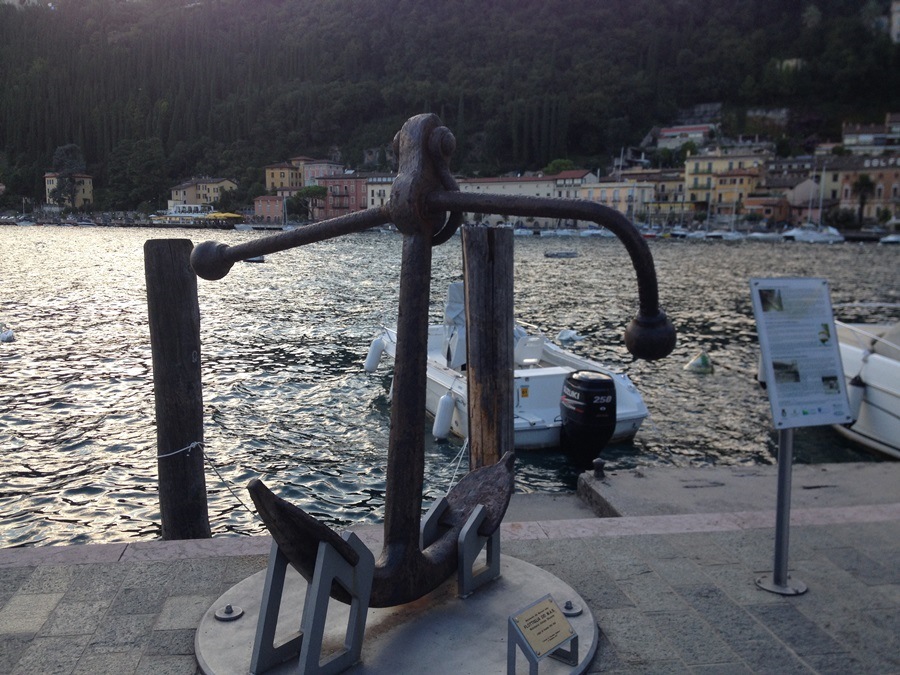
It’s a 478kg anchor pulled out from the bottom of the lake in 2011. It was used to anchor a big circular buoy where in 1918 3 MAS (torpedo-armed motorboat) were moored, sent by the Navy the last year of WWI in order to defend from enemy attacks, since the area was considered a front line zone. It commemorates the fallen of the Navy'
});
t.setStyle(
new ol.style.Style({
image: new ol.style.Circle({
fill: new ol.style.Fill({
color: '#00f93b'
}),
radius: 8,
stroke: new ol.style.Stroke({
color: '#000000',
width: 1,
}),
}),
}),
);
iconList.push(t);
style['701'] = {
'Point': new ol.style.Style({
image: new ol.style.Circle({
fill: new ol.style.Fill({
color: 'rgba(255,255,0,0.6)',
}),
radius: 10,
stroke: new ol.style.Stroke({
color: '#ff0',
width: 1,
}),
}),
}),
'LineString': new ol.style.Style({
stroke: new ol.style.Stroke({
color: '#00f93b',
width: 3,
}),
}),
'MultiLineString': new ol.style.Style({
stroke: new ol.style.Stroke({
color: '#00f93b',
width: 3,
}),
}),
};
// GPX start
var t = new ol.Feature({
geometry: new ol.geom.Point(ol.proj.fromLonLat([10.598521, 45.635838])),
name: 'Bella Italia',
description: '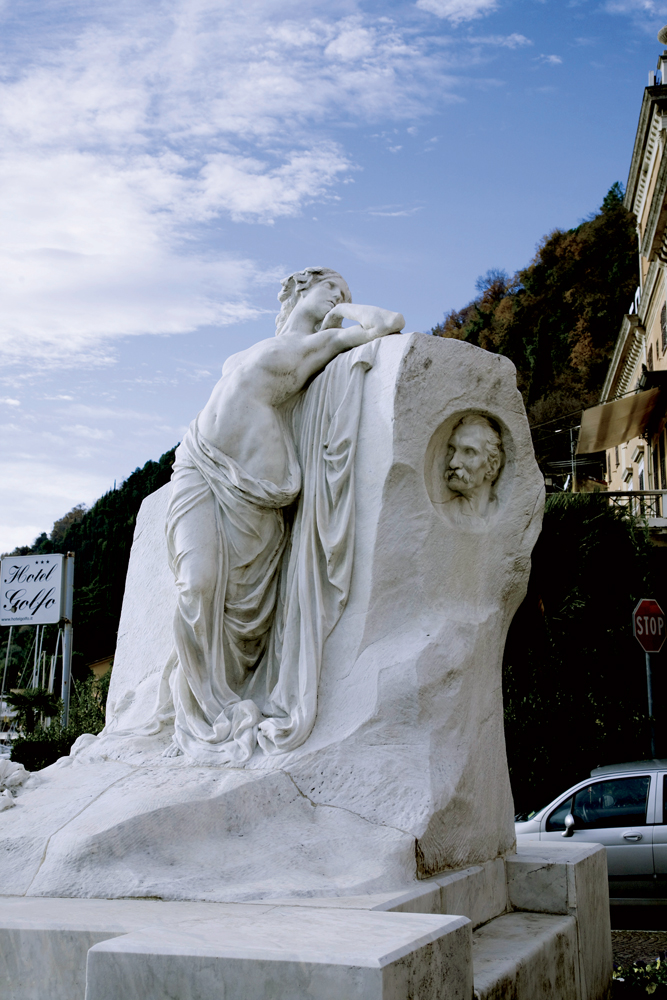
Inaugurated in 1909 in honour of the stateman and Prime Minister Giuseppe Zanardelli, who lived in Bornico for years. The statue was made by the artist Leonardo Bistolfi. Originally the face of the woman, symbol of the Homeland, looked towards Trieste, that at the time was under the Austria Empire. She was defined as “The desire of a far shore”. On the base is an inscription to Giuseppe zanardelli. The monument was rotated towards north in 1939 when the square was renovated.'
});
t.setStyle(
new ol.style.Style({
image: new ol.style.Circle({
fill: new ol.style.Fill({
color: '#00f93b'
}),
radius: 8,
stroke: new ol.style.Stroke({
color: '#000000',
width: 1,
}),
}),
}),
);
iconList.push(t);
style['741'] = {
'Point': new ol.style.Style({
image: new ol.style.Circle({
fill: new ol.style.Fill({
color: 'rgba(255,255,0,0.6)',
}),
radius: 10,
stroke: new ol.style.Stroke({
color: '#ff0',
width: 1,
}),
}),
}),
'LineString': new ol.style.Style({
stroke: new ol.style.Stroke({
color: '#00f93b',
width: 3,
}),
}),
'MultiLineString': new ol.style.Style({
stroke: new ol.style.Stroke({
color: '#00f93b',
width: 3,
}),
}),
};
// GPX start
var t = new ol.Feature({
geometry: new ol.geom.Point(ol.proj.fromLonLat([10.6072463201474, 45.640496226946865])),
name: 'Elementary school',
description: '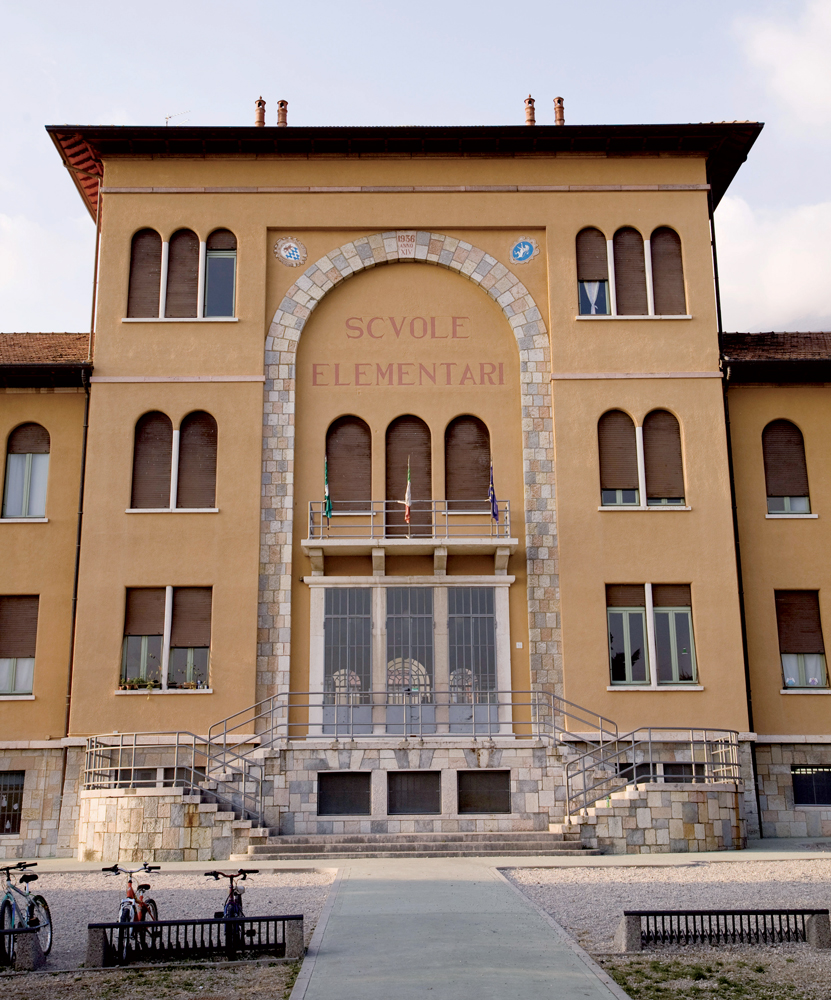
The Elementary school building was the seat of the Ministero dell’Interno. Here there were the Police offices and Herbert Kappler’s office, Major of the SS'
});
t.setStyle(
new ol.style.Style({
image: new ol.style.Circle({
fill: new ol.style.Fill({
color: '#00f93b'
}),
radius: 8,
stroke: new ol.style.Stroke({
color: '#000000',
width: 1,
}),
}),
}),
);
iconList.push(t);
style['708'] = {
'Point': new ol.style.Style({
image: new ol.style.Circle({
fill: new ol.style.Fill({
color: 'rgba(255,255,0,0.6)',
}),
radius: 10,
stroke: new ol.style.Stroke({
color: '#ff0',
width: 1,
}),
}),
}),
'LineString': new ol.style.Style({
stroke: new ol.style.Stroke({
color: '#00f93b',
width: 3,
}),
}),
'MultiLineString': new ol.style.Style({
stroke: new ol.style.Stroke({
color: '#00f93b',
width: 3,
}),
}),
};
// GPX start
var t = new ol.Feature({
geometry: new ol.geom.Point(ol.proj.fromLonLat([10.605664073434726, 45.63672265292951])),
name: 'Monument to the Fallen',
description: '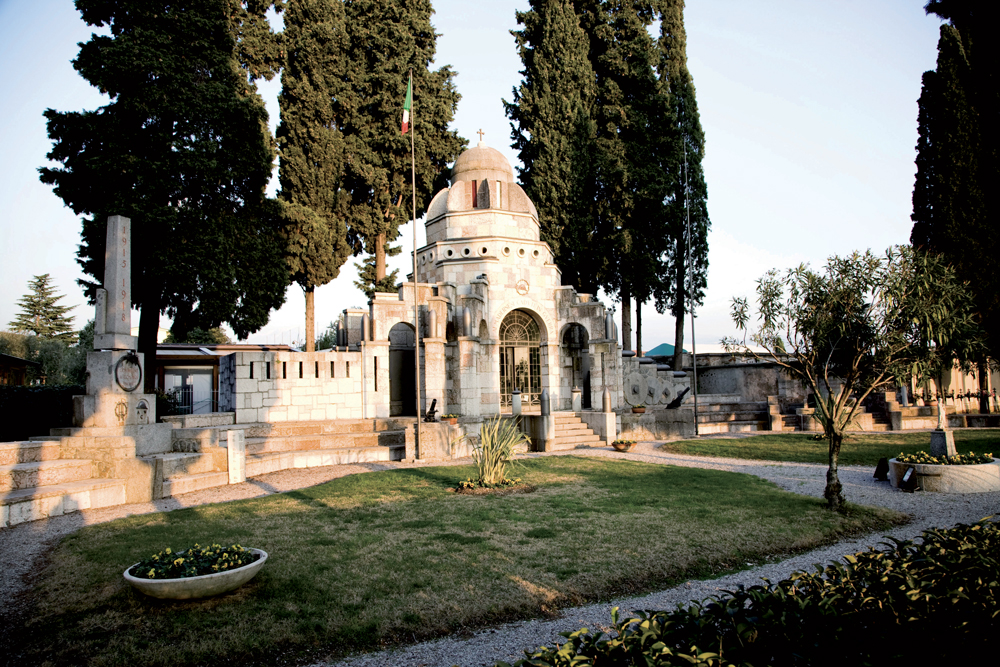
Monument dedicated to the fallen of the First World War of Toscolano Maderno, inaugurated in 1937 and realized by Dubbini. This monument has several remains connecte to the most important local activieties: olive oil and paper production On the left side there is a chiselled stone that reminds the Italian soldiers, with the text “beyond the blaze, the enemy rage doesn’t live”. This stone is connected to the traditional paper production, it was part of a set of hammers that beat the rags used to make paper. The fountain on the right corner represents the renewal of life and it was built on a stone used in paper mills as well.'
});
t.setStyle(
new ol.style.Style({
image: new ol.style.Circle({
fill: new ol.style.Fill({
color: '#00f93b'
}),
radius: 8,
stroke: new ol.style.Stroke({
color: '#000000',
width: 1,
}),
}),
}),
);
iconList.push(t);
style['735'] = {
'Point': new ol.style.Style({
image: new ol.style.Circle({
fill: new ol.style.Fill({
color: 'rgba(255,255,0,0.6)',
}),
radius: 10,
stroke: new ol.style.Stroke({
color: '#ff0',
width: 1,
}),
}),
}),
'LineString': new ol.style.Style({
stroke: new ol.style.Stroke({
color: '#00f93b',
width: 3,
}),
}),
'MultiLineString': new ol.style.Style({
stroke: new ol.style.Stroke({
color: '#00f93b',
width: 3,
}),
}),
};
// GPX start
var t = new ol.Feature({
geometry: new ol.geom.Point(ol.proj.fromLonLat([10.599601, 45.635236])),
name: 'Monumento of St. Ercolano',
description: '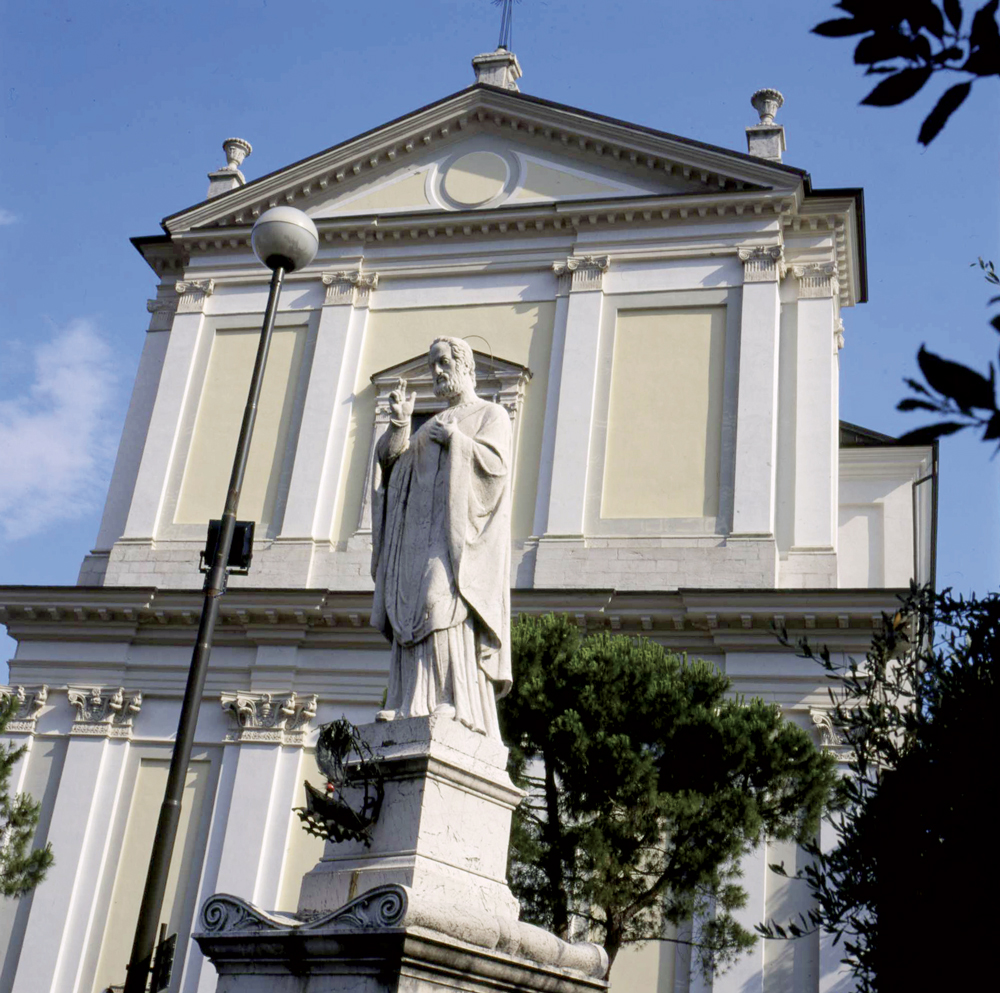
The marble statue is dedicated to St. Ercolano, the patron saint of Maderno and also of the Riviera, celebrated on August 12. It was built in 1838 by the sculptor Cesare Nesti and Adamo Tagliani. It was the result of a promise made by the people of Maderno, when an epidemic of cholera broke out in July 1836.
They asked to S. Ercolano to protect the population. In September the epidemic was over and the statue was then built
'
});
t.setStyle(
new ol.style.Style({
image: new ol.style.Circle({
fill: new ol.style.Fill({
color: '#00f93b'
}),
radius: 8,
stroke: new ol.style.Stroke({
color: '#000000',
width: 1,
}),
}),
}),
);
iconList.push(t);
style['716'] = {
'Point': new ol.style.Style({
image: new ol.style.Circle({
fill: new ol.style.Fill({
color: 'rgba(255,255,0,0.6)',
}),
radius: 10,
stroke: new ol.style.Stroke({
color: '#ff0',
width: 1,
}),
}),
}),
'LineString': new ol.style.Style({
stroke: new ol.style.Stroke({
color: '#00f93b',
width: 3,
}),
}),
'MultiLineString': new ol.style.Style({
stroke: new ol.style.Stroke({
color: '#00f93b',
width: 3,
}),
}),
};
// GPX start
var t = new ol.Feature({
geometry: new ol.geom.Point(ol.proj.fromLonLat([10.607736729452402, 45.63983024327686])),
name: 'Statues of three Saints',
description: '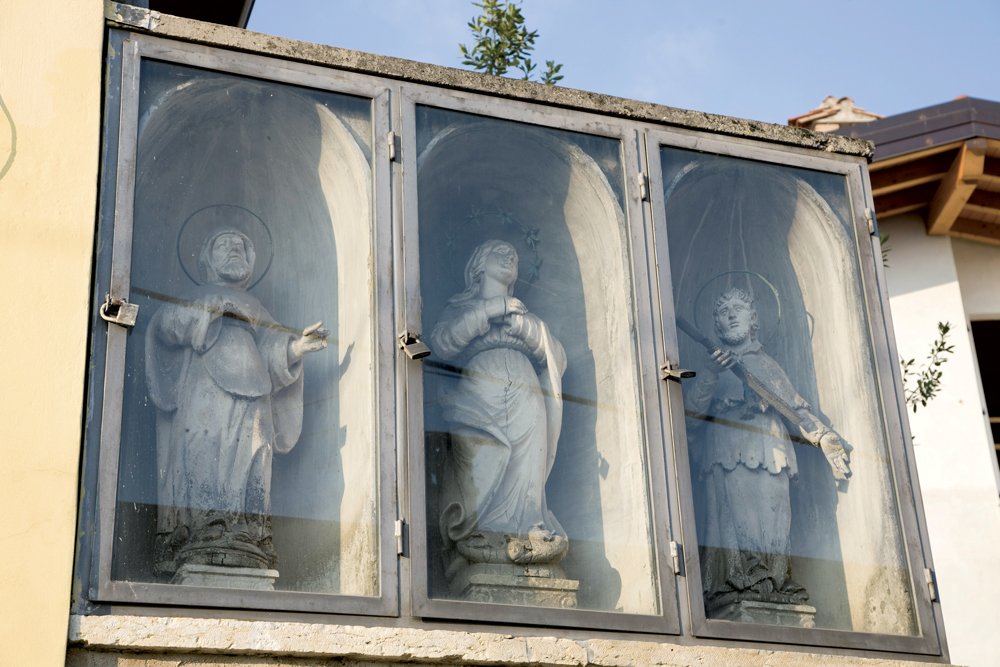
They represent the Virgin, St. Francesco d\'Assisi and San Giovanni Nepomuceno.
The statues belonged to Marshall Giuseppe Ferrari and originally they were on the portal of his palace
'
});
t.setStyle(
new ol.style.Style({
image: new ol.style.Circle({
fill: new ol.style.Fill({
color: '#00f93b'
}),
radius: 8,
stroke: new ol.style.Stroke({
color: '#000000',
width: 1,
}),
}),
}),
);
iconList.push(t);
style['718'] = {
'Point': new ol.style.Style({
image: new ol.style.Circle({
fill: new ol.style.Fill({
color: 'rgba(255,255,0,0.6)',
}),
radius: 10,
stroke: new ol.style.Stroke({
color: '#ff0',
width: 1,
}),
}),
}),
'LineString': new ol.style.Style({
stroke: new ol.style.Stroke({
color: '#00f93b',
width: 3,
}),
}),
'MultiLineString': new ol.style.Style({
stroke: new ol.style.Stroke({
color: '#00f93b',
width: 3,
}),
}),
};
// GPX start
var t = new ol.Feature({
geometry: new ol.geom.Point(ol.proj.fromLonLat([10.598902, 45.635768])),
name: 'The Lion and S. Marco square',
description: '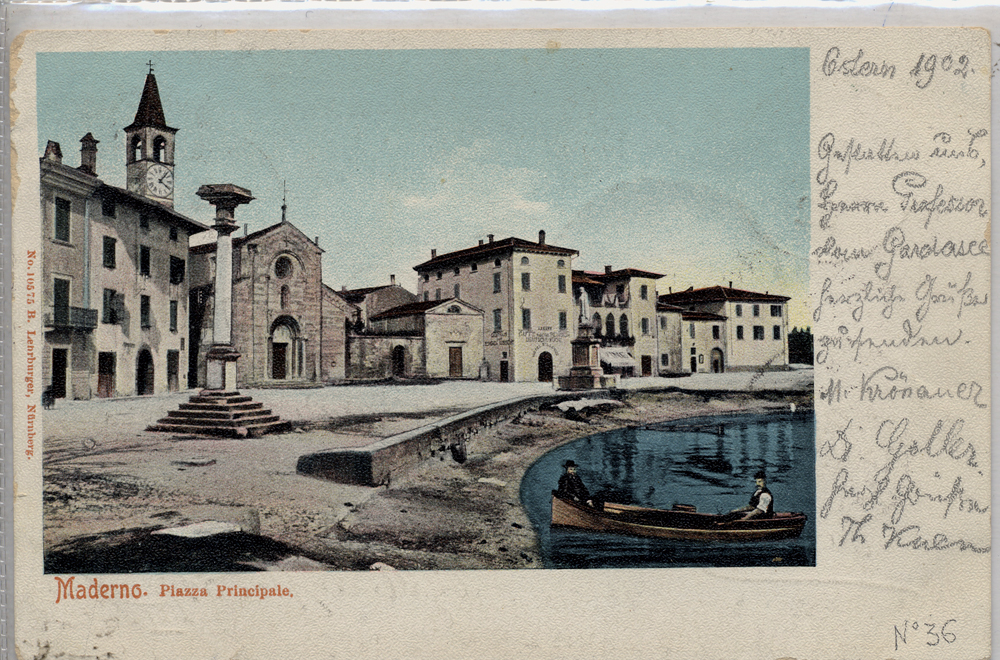
The column, symbol of the Serenissima Republic of Venice was built in 1610 in front of the old town hall of Maderno. On the base the are low reliefs representing Saint Andrew, patron saint of Maderno, and Saint Herculanums, patron saint of the entire Riviera. According to the local tradition, when the Republic of Venice fell in 1797, the original stone lion was thrown into the giulf. The current bronze sculpture was made in 1902 by Ettore Ximenes (Palermo, 1855 – Rome, 1926) who donated it to the community of Maderno.'
});
t.setStyle(
new ol.style.Style({
image: new ol.style.Circle({
fill: new ol.style.Fill({
color: '#00f93b'
}),
radius: 8,
stroke: new ol.style.Stroke({
color: '#000000',
width: 1,
}),
}),
}),
);
iconList.push(t);
var iconLayer = new ol.layer.Vector({
source: new ol.source.Vector({
features: iconList,
}),
});
vectorList_16.push(iconLayer);
var vectorList_23 = [];
var iconList = [];
style['732'] = {
'Point': new ol.style.Style({
image: new ol.style.Circle({
fill: new ol.style.Fill({
color: 'rgba(255,255,0,0.6)',
}),
radius: 10,
stroke: new ol.style.Stroke({
color: '#ff0',
width: 1,
}),
}),
}),
'LineString': new ol.style.Style({
stroke: new ol.style.Stroke({
color: '#385e39',
width: 3,
}),
}),
'MultiLineString': new ol.style.Style({
stroke: new ol.style.Stroke({
color: '#385e39',
width: 3,
}),
}),
};
// GPX start
var t = new ol.Feature({
geometry: new ol.geom.Point(ol.proj.fromLonLat([10.600225465178168, 45.63463308569395])),
name: 'Bell Tower (Ex Castle)',
description: 'It\'s the only part remaining of the big castle, probably built during the VIII Century. It had a double row of curtain walls, surrounded by a moat, with 4 towers. On the side of the square there was the drawbridge.Inside of the castle, that faced a wide courtyard, there was a Palace that from 1336 was the seat of the administration of the Comunità di Riviera and then residence of the Vicar of the Magnifica Patria. The palace and the castle were severely dameged by a fire in 1645 and demolished (except the tower) in order to build the parish church a century after.
'
});
t.setStyle(
new ol.style.Style({
image: new ol.style.Circle({
fill: new ol.style.Fill({
color: '#385e39'
}),
radius: 8,
stroke: new ol.style.Stroke({
color: '#000000',
width: 1,
}),
}),
}),
);
iconList.push(t);
style['770'] = {
'Point': new ol.style.Style({
image: new ol.style.Circle({
fill: new ol.style.Fill({
color: 'rgba(255,255,0,0.6)',
}),
radius: 10,
stroke: new ol.style.Stroke({
color: '#ff0',
width: 1,
}),
}),
}),
'LineString': new ol.style.Style({
stroke: new ol.style.Stroke({
color: '#385e39',
width: 3,
}),
}),
'MultiLineString': new ol.style.Style({
stroke: new ol.style.Stroke({
color: '#385e39',
width: 3,
}),
}),
};
// GPX start
var t = new ol.Feature({
geometry: new ol.geom.Point(ol.proj.fromLonLat([10.604022848351109, 45.63963246185194])),
name: 'Fontane',
description: '
'
});
t.setStyle(
new ol.style.Style({
image: new ol.style.Circle({
fill: new ol.style.Fill({
color: '#385e39'
}),
radius: 8,
stroke: new ol.style.Stroke({
color: '#000000',
width: 1,
}),
}),
}),
);
iconList.push(t);
style['744'] = {
'Point': new ol.style.Style({
image: new ol.style.Circle({
fill: new ol.style.Fill({
color: 'rgba(255,255,0,0.6)',
}),
radius: 10,
stroke: new ol.style.Stroke({
color: '#ff0',
width: 1,
}),
}),
}),
'LineString': new ol.style.Style({
stroke: new ol.style.Stroke({
color: '#385e39',
width: 3,
}),
}),
'MultiLineString': new ol.style.Style({
stroke: new ol.style.Stroke({
color: '#385e39',
width: 3,
}),
}),
};
// GPX start
var t = new ol.Feature({
geometry: new ol.geom.Point(ol.proj.fromLonLat([10.608396690330533, 45.64106543677046])),
name: 'Former Town Hall',
description: '.jpg)
It belonged to Ettore Bianchi, who had been manager of the Maffizzoli Papermill for several years, it is now seat of the Library and the Ecomuseum. On the base of the balcony the writing NULLA DIES SINE LINE, \"not a day without tracing a line\" a quote attributed to Apelles.'
});
t.setStyle(
new ol.style.Style({
image: new ol.style.Circle({
fill: new ol.style.Fill({
color: '#385e39'
}),
radius: 8,
stroke: new ol.style.Stroke({
color: '#000000',
width: 1,
}),
}),
}),
);
iconList.push(t);
style['730'] = {
'Point': new ol.style.Style({
image: new ol.style.Circle({
fill: new ol.style.Fill({
color: 'rgba(255,255,0,0.6)',
}),
radius: 10,
stroke: new ol.style.Stroke({
color: '#ff0',
width: 1,
}),
}),
}),
'LineString': new ol.style.Style({
stroke: new ol.style.Stroke({
color: '#385e39',
width: 3,
}),
}),
'MultiLineString': new ol.style.Style({
stroke: new ol.style.Stroke({
color: '#385e39',
width: 3,
}),
}),
};
// GPX start
var t = new ol.Feature({
geometry: new ol.geom.Point(ol.proj.fromLonLat([10.609055700445758, 45.64140801163121])),
name: 'The old Bridge',
description: 'So called to distinguish it from the new bridge built in 1908, it dates back to the early 16th Century and its construction was ordered in 1497, payed by the Magnifica Patria. They say that up until mid 19th Century on the parapet towards the mount there were two niches, one with a fragment of a sculpture representing a woman with a tiara.
Here there was Contrada Ponte (bridge), the first contrada of Toscolano for those arriving from Maderno and it was crossed by the Strada Regia that continued in via Trento.
Before the contruction of the bridge people crossed the river through fords
'
});
t.setStyle(
new ol.style.Style({
image: new ol.style.Circle({
fill: new ol.style.Fill({
color: '#385e39'
}),
radius: 8,
stroke: new ol.style.Stroke({
color: '#000000',
width: 1,
}),
}),
}),
);
iconList.push(t);
style['710'] = {
'Point': new ol.style.Style({
image: new ol.style.Circle({
fill: new ol.style.Fill({
color: 'rgba(255,255,0,0.6)',
}),
radius: 10,
stroke: new ol.style.Stroke({
color: '#ff0',
width: 1,
}),
}),
}),
'LineString': new ol.style.Style({
stroke: new ol.style.Stroke({
color: '#385e39',
width: 3,
}),
}),
'MultiLineString': new ol.style.Style({
stroke: new ol.style.Stroke({
color: '#385e39',
width: 3,
}),
}),
};
// GPX start
var t = new ol.Feature({
geometry: new ol.geom.Point(ol.proj.fromLonLat([10.61918884246249, 45.64606058703979])),
name: 'The Toscolano Harbor',
description: '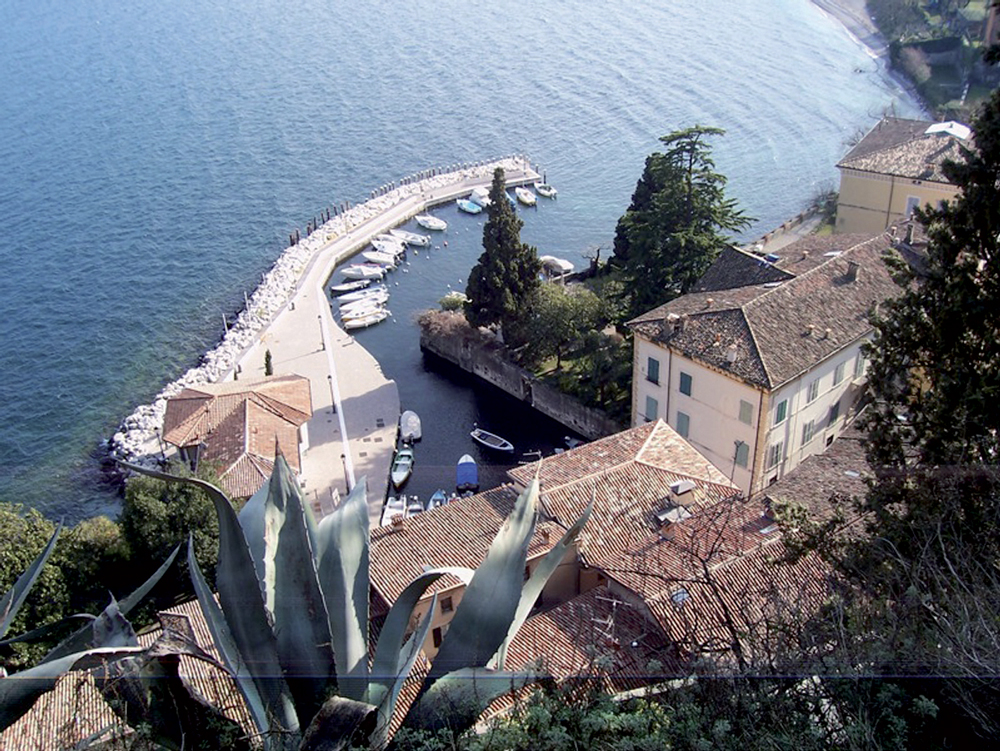
Charming and quiet, the small harbour is surrounded by ancient buildings once inhabited by noble families, such as the Delai Palace on the left of the square, that dates back to the XVII Century and preserves beautiful frescoes. Between the 15th and the 17th century it was a busy distribution centre of goods and iron, where the boats came from and went to Venice.
From the harbour of Toscolano you can admire what remains of one of the many lemon gardens which dotted the territory of Toscolano until the beginning of the XX century and represented a major source of local income. Citrus fruits grown, especially lemons, were exported across Europe. The cultivation was probably introduced by Franciscan friars in the thirteenth century and abandoned in the early twentieth century because it was no longer competitive.
'
});
t.setStyle(
new ol.style.Style({
image: new ol.style.Circle({
fill: new ol.style.Fill({
color: '#385e39'
}),
radius: 8,
stroke: new ol.style.Stroke({
color: '#000000',
width: 1,
}),
}),
}),
);
iconList.push(t);
style['703'] = {
'Point': new ol.style.Style({
image: new ol.style.Circle({
fill: new ol.style.Fill({
color: 'rgba(255,255,0,0.6)',
}),
radius: 10,
stroke: new ol.style.Stroke({
color: '#ff0',
width: 1,
}),
}),
}),
'LineString': new ol.style.Style({
stroke: new ol.style.Stroke({
color: '#385e39',
width: 3,
}),
}),
'MultiLineString': new ol.style.Style({
stroke: new ol.style.Stroke({
color: '#385e39',
width: 3,
}),
}),
};
// GPX start
var t = new ol.Feature({
geometry: new ol.geom.Point(ol.proj.fromLonLat([10.616500971707813, 45.6408105071995])),
name: 'The Toscolano Papermill',
description: '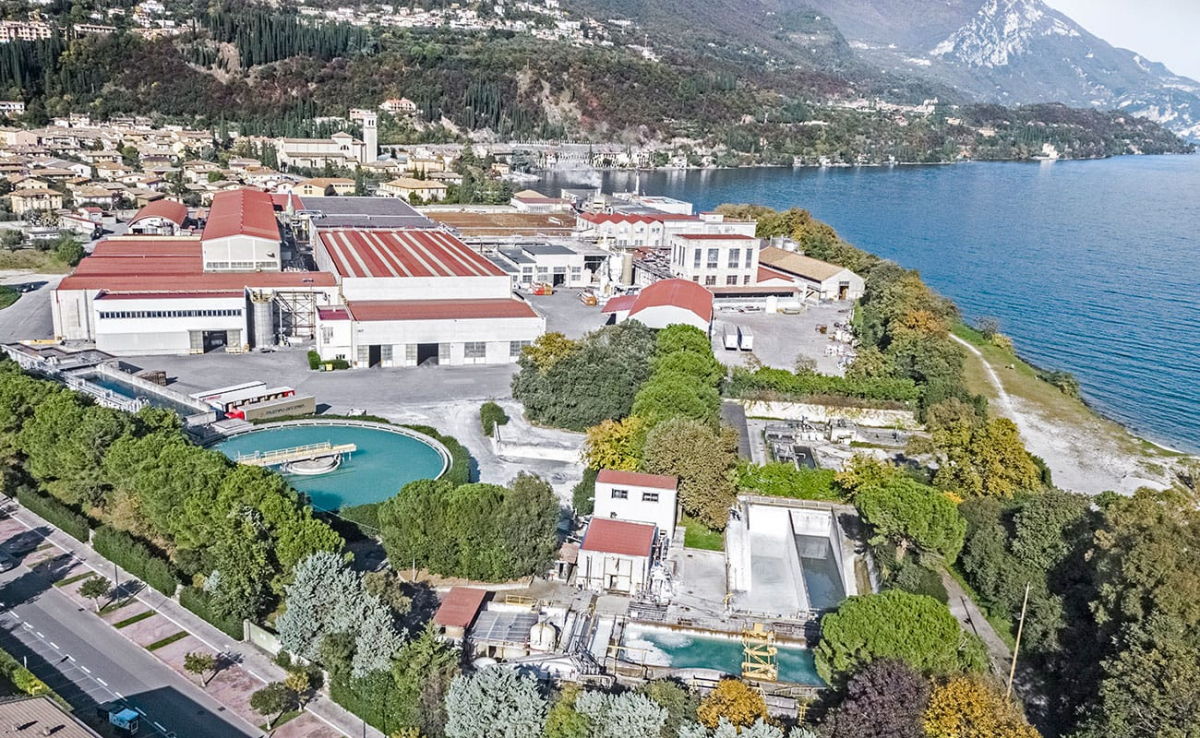
The papermill of Toscolano was built thanks to Andrea Maffizzoli and the Maffizzoli Brothers Company who were already the owners of some papermills in the Valley and they wanted to build a new papermill on the lakeshore, in Capra, equipped with the most modern machinery for paper production. The construction begun in 1906 and the papermill officially opened on March 19th 1910. In 1927 the 5 Maffizzoli’s papermills had 1100 workers. In 1945 the building in Toscolano was bombed and semi destroyed by the Allied.
From 1989 has been part of the Marchi Group and from 2007 of the Burgo Group. The papermill hires now 370 workers'
});
t.setStyle(
new ol.style.Style({
image: new ol.style.Circle({
fill: new ol.style.Fill({
color: '#385e39'
}),
radius: 8,
stroke: new ol.style.Stroke({
color: '#000000',
width: 1,
}),
}),
}),
);
iconList.push(t);
style['699'] = {
'Point': new ol.style.Style({
image: new ol.style.Circle({
fill: new ol.style.Fill({
color: 'rgba(255,255,0,0.6)',
}),
radius: 10,
stroke: new ol.style.Stroke({
color: '#ff0',
width: 1,
}),
}),
}),
'LineString': new ol.style.Style({
stroke: new ol.style.Stroke({
color: '#385e39',
width: 3,
}),
}),
'MultiLineString': new ol.style.Style({
stroke: new ol.style.Stroke({
color: '#385e39',
width: 3,
}),
}),
};
// GPX start
var t = new ol.Feature({
geometry: new ol.geom.Point(ol.proj.fromLonLat([10.596475, 45.635198])),
name: 'Wash house',
description: '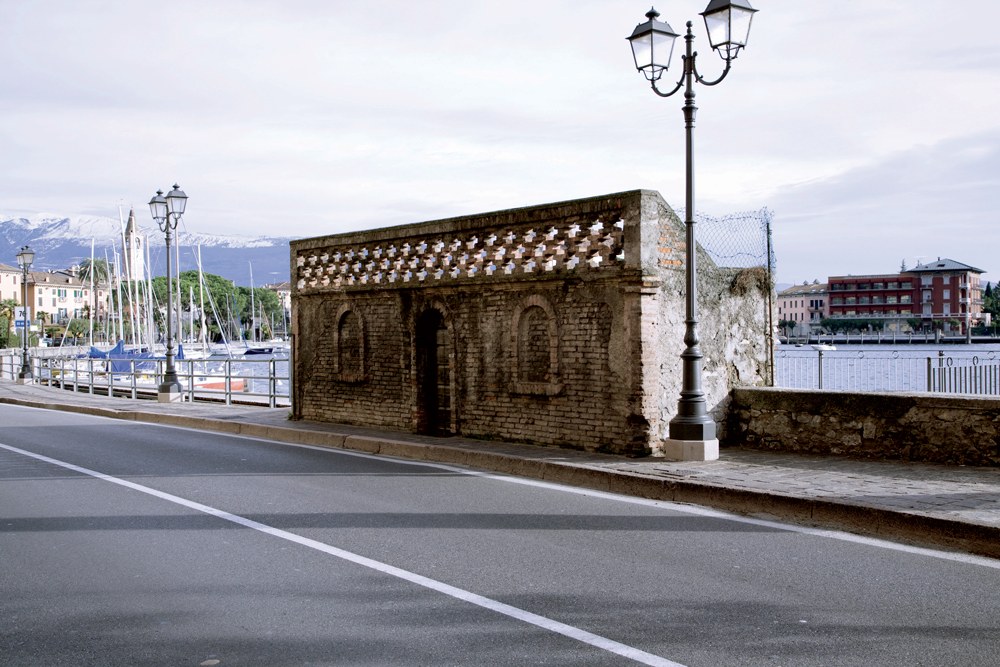
It dates back to the 19th Century and it belonged to the Park Hotel, one of the first hotels built in Maderno.
Between the hotel and the wash house there was a garden, expropriated in 1899 for the construction of the road.'
});
t.setStyle(
new ol.style.Style({
image: new ol.style.Circle({
fill: new ol.style.Fill({
color: '#385e39'
}),
radius: 8,
stroke: new ol.style.Stroke({
color: '#000000',
width: 1,
}),
}),
}),
);
iconList.push(t);
var iconLayer = new ol.layer.Vector({
source: new ol.source.Vector({
features: iconList,
}),
});
vectorList_23.push(iconLayer);
var vectorList_27 = [];
var iconList = [];
style['739'] = {
'Point': new ol.style.Style({
image: new ol.style.Circle({
fill: new ol.style.Fill({
color: 'rgba(255,255,0,0.6)',
}),
radius: 10,
stroke: new ol.style.Stroke({
color: '#ff0',
width: 1,
}),
}),
}),
'LineString': new ol.style.Style({
stroke: new ol.style.Stroke({
color: '#e7ceb0',
width: 3,
}),
}),
'MultiLineString': new ol.style.Style({
stroke: new ol.style.Stroke({
color: '#e7ceb0',
width: 3,
}),
}),
};
// GPX start
var t = new ol.Feature({
geometry: new ol.geom.Point(ol.proj.fromLonLat([10.600376275448935, 45.63626531979006])),
name: 'Benamati Palace',
description: '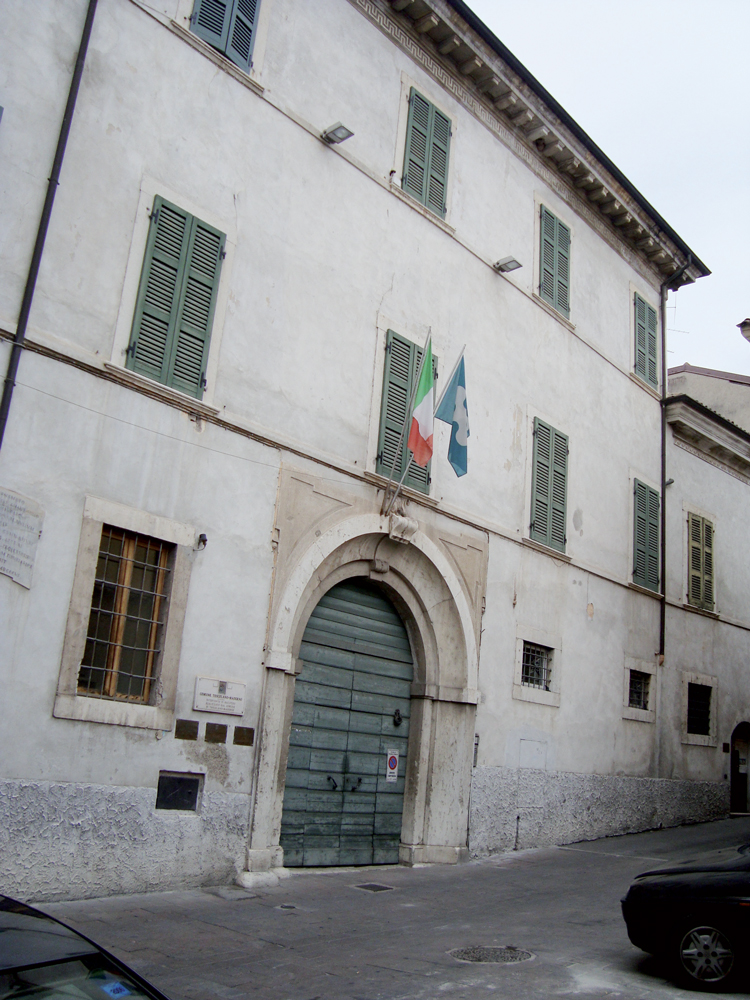
Palazzo Benamati was designated by his owner, Don Cristoforo Benamati, who died in 1799, as the seat of a school for children from Maderno. It was the seat of the elementary school until 1927 and kindergarten until the 70s. Today it is the location for cultural events, shows and concerts.
Inside, the big hall is dedicated to Andrea Celesti.
Traces of the 18th Century decorations are stil visible today.
The painting in the hall comes from Villa Serraglio and it represents a burning city
'
});
t.setStyle(
new ol.style.Style({
image: new ol.style.Circle({
fill: new ol.style.Fill({
color: '#e7ceb0'
}),
radius: 8,
stroke: new ol.style.Stroke({
color: '#000000',
width: 1,
}),
}),
}),
);
iconList.push(t);
style['727'] = {
'Point': new ol.style.Style({
image: new ol.style.Circle({
fill: new ol.style.Fill({
color: 'rgba(255,255,0,0.6)',
}),
radius: 10,
stroke: new ol.style.Stroke({
color: '#ff0',
width: 1,
}),
}),
}),
'LineString': new ol.style.Style({
stroke: new ol.style.Stroke({
color: '#e7ceb0',
width: 3,
}),
}),
'MultiLineString': new ol.style.Style({
stroke: new ol.style.Stroke({
color: '#e7ceb0',
width: 3,
}),
}),
};
// GPX start
var t = new ol.Feature({
geometry: new ol.geom.Point(ol.proj.fromLonLat([10.600610283346228, 45.63753490873119])),
name: 'Bulgheroni Palace',
description: '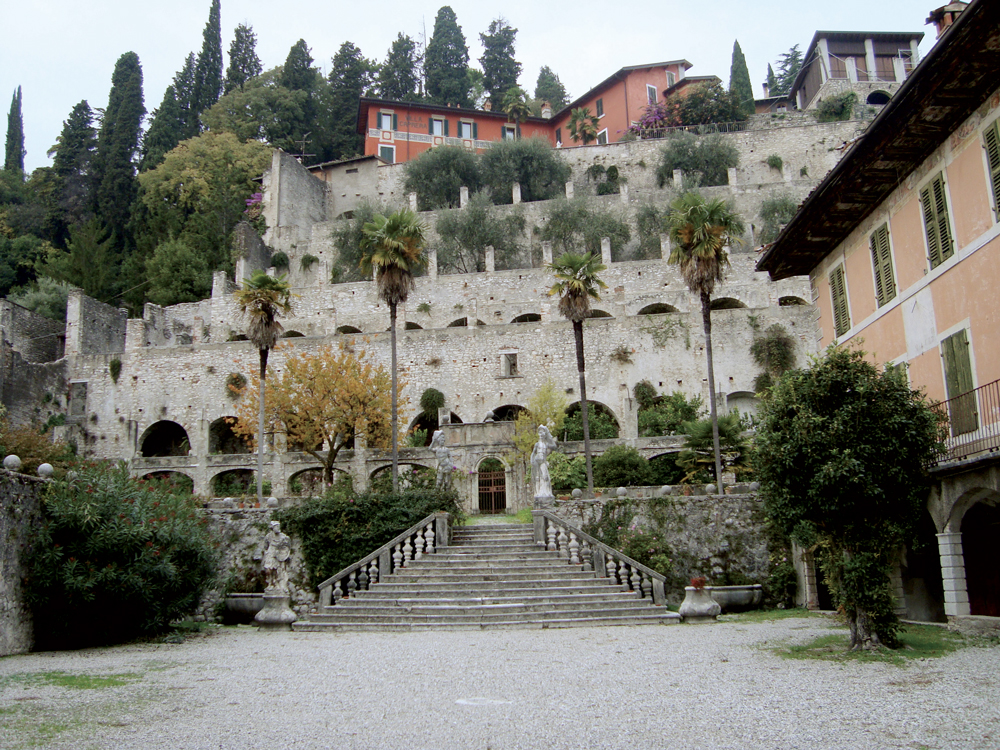
Palazzo Bulgheroni, also known as Villa Lucia, belongs to an elegant historical complex surrounded by a wide wall surmonted by big stone balls with a small tower in its corner. The big ashlar gate opens on a garden towards which the villa is faced to and a scenographic staircase with satues, vats and mascarons that leads to the terraces of an old lemon garden. The palace has an interesting frescoed frieze beneath the roof with putti and mythological figures. The plan of the building dates back to the XVII C. In 1707 the property beloged to the counts Rizzardi, whose emblems are on the shield of one of the statues on the staircase. From the end of the XIX C, it belonged to the Bulgheroni Family.'
});
t.setStyle(
new ol.style.Style({
image: new ol.style.Circle({
fill: new ol.style.Fill({
color: '#e7ceb0'
}),
radius: 8,
stroke: new ol.style.Stroke({
color: '#000000',
width: 1,
}),
}),
}),
);
iconList.push(t);
style['740'] = {
'Point': new ol.style.Style({
image: new ol.style.Circle({
fill: new ol.style.Fill({
color: 'rgba(255,255,0,0.6)',
}),
radius: 10,
stroke: new ol.style.Stroke({
color: '#ff0',
width: 1,
}),
}),
}),
'LineString': new ol.style.Style({
stroke: new ol.style.Stroke({
color: '#e7ceb0',
width: 3,
}),
}),
'MultiLineString': new ol.style.Style({
stroke: new ol.style.Stroke({
color: '#e7ceb0',
width: 3,
}),
}),
};
// GPX start
var t = new ol.Feature({
geometry: new ol.geom.Point(ol.proj.fromLonLat([10.618579915812077, 45.64616360829389])),
name: 'Delai Palace',
description: '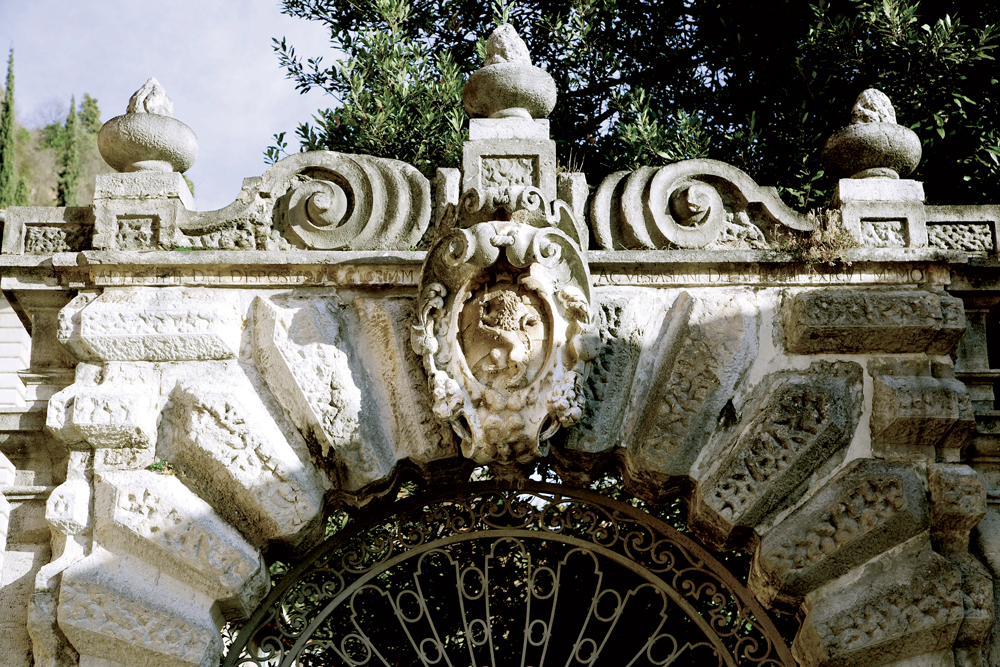
The palace dates back to the 17th Century, flanked by several lemon groves, still visible today, a garden on the lakeshore and has fine frescoes on the external plasters. Here, Scipione Delai hosted Andrea Celesti, who realized numerous canvases fo this palace, today in Brescia.
The property passed to the Maffizzoli and the Oldi'
});
t.setStyle(
new ol.style.Style({
image: new ol.style.Circle({
fill: new ol.style.Fill({
color: '#e7ceb0'
}),
radius: 8,
stroke: new ol.style.Stroke({
color: '#000000',
width: 1,
}),
}),
}),
);
iconList.push(t);
style['709'] = {
'Point': new ol.style.Style({
image: new ol.style.Circle({
fill: new ol.style.Fill({
color: 'rgba(255,255,0,0.6)',
}),
radius: 10,
stroke: new ol.style.Stroke({
color: '#ff0',
width: 1,
}),
}),
}),
'LineString': new ol.style.Style({
stroke: new ol.style.Stroke({
color: '#e7ceb0',
width: 3,
}),
}),
'MultiLineString': new ol.style.Style({
stroke: new ol.style.Stroke({
color: '#e7ceb0',
width: 3,
}),
}),
};
// GPX start
var t = new ol.Feature({
geometry: new ol.geom.Point(ol.proj.fromLonLat([10.600314439165508, 45.63644853732234])),
name: 'Gonzaga Palace',
description: '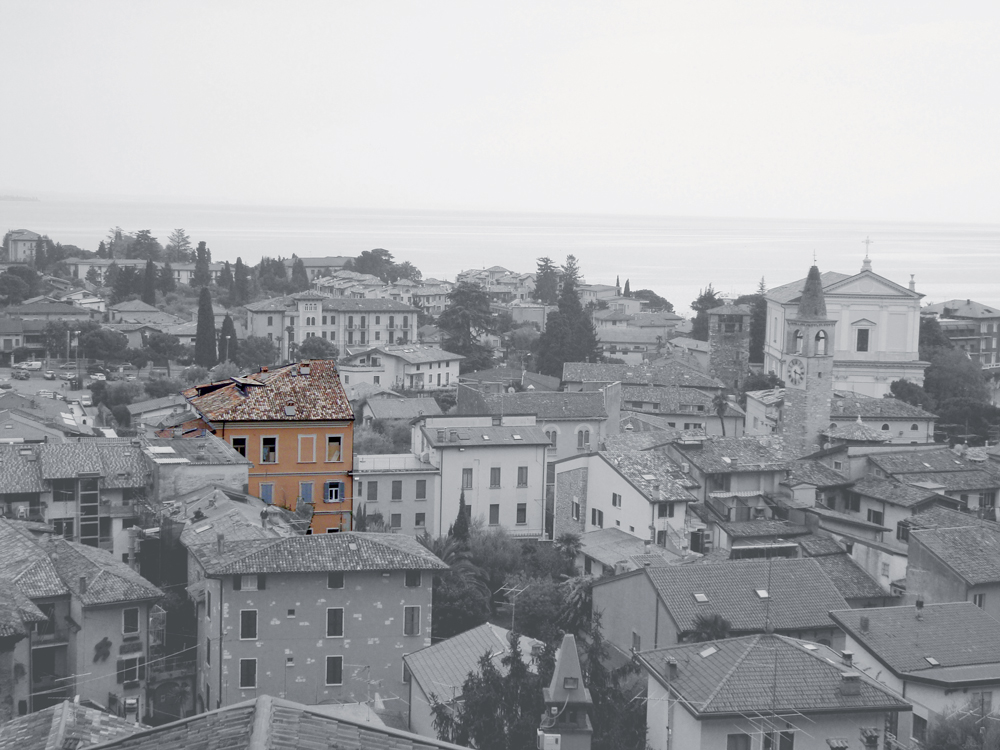
In the 19th Century the palace was partly damaged, and what we can see today it is only one third of the original building. On the ground floor (known as “piano nobile” in Italian) the doors and the walls are preciously decorated with 17th Century motifs. Interesting facts: Most of the decoration left recreates an illusory appearance of a Baroque architecture by the use of peculiar colors and art technique resembling movements. All over the place you can see between the columns, balustrades and recesses in the walls different paintings such as flower vases and garlands, idyllic landscapes, portraits and mythological scenes.
Besides the amazing decoration of the interiors, there was an outstanding park outside, stretching over 70 hectares, between the palace and the lakeshore. To walk down, there was a pathway passing through different kind of trees, such as laurels, olive trees and mulberries and leading near the area now known as “ex campo ippico” (which means “former hippodrome”). From a drawing, year 1623, we know that it was surrounded by geometrically-shaped boxwood beds. On the side of the garden there were rows of lemon greenhouses (the definition found in an old document says “ walled cedar greenhouses”), special greenhouses to growing citrus fruits. Interesting facts: From an old inventory we found out that in the greenhouses of the Gonzaga’s during the lemon harvesting season in 1635, they gathered 22.600 lemons, each measuring 18 cm (about 7 inches) in circumference and there were 60.000 lemons already ripen but still hanging on the trees.'
});
t.setStyle(
new ol.style.Style({
image: new ol.style.Circle({
fill: new ol.style.Fill({
color: '#e7ceb0'
}),
radius: 8,
stroke: new ol.style.Stroke({
color: '#000000',
width: 1,
}),
}),
}),
);
iconList.push(t);
style['771'] = {
'Point': new ol.style.Style({
image: new ol.style.Circle({
fill: new ol.style.Fill({
color: 'rgba(255,255,0,0.6)',
}),
radius: 10,
stroke: new ol.style.Stroke({
color: '#ff0',
width: 1,
}),
}),
}),
'LineString': new ol.style.Style({
stroke: new ol.style.Stroke({
color: '#e7ceb0',
width: 3,
}),
}),
'MultiLineString': new ol.style.Style({
stroke: new ol.style.Stroke({
color: '#e7ceb0',
width: 3,
}),
}),
};
// GPX start
var t = new ol.Feature({
geometry: new ol.geom.Point(ol.proj.fromLonLat([10.605244, 45.652062])),
name: 'Maffizzoli Palace',
description: '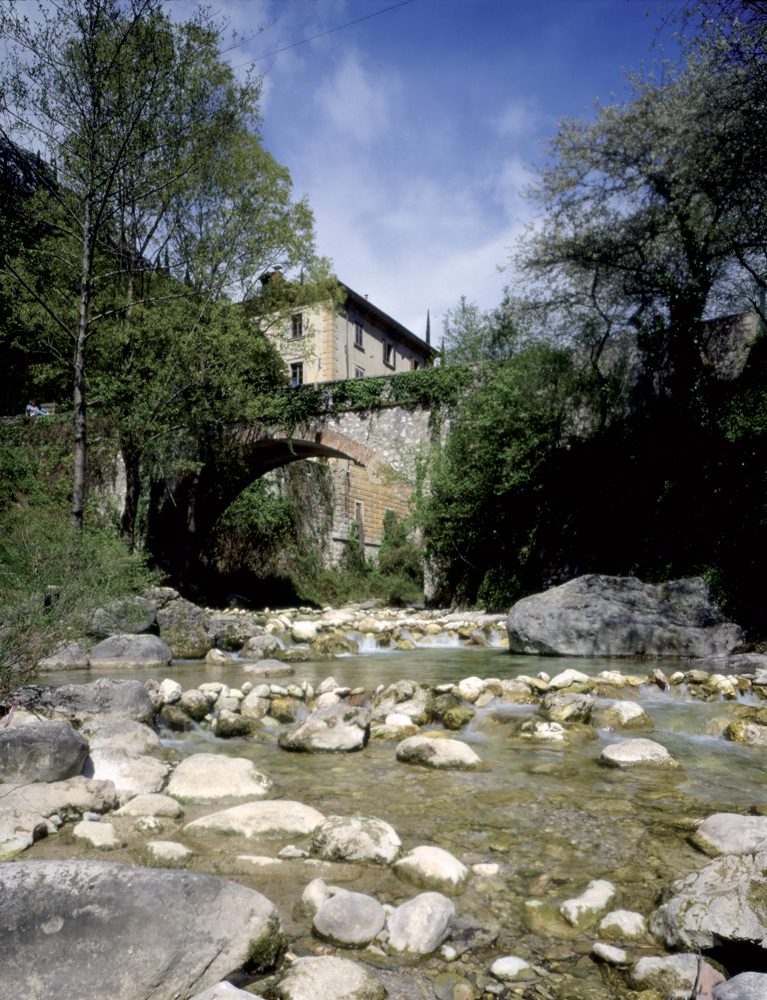
Property of the Maffizzoli family, famous paper makers. It was built on the side of the river at the entrance of Maina Superiore, that was the main paper production centre at the end of the 19th Century'
});
t.setStyle(
new ol.style.Style({
image: new ol.style.Circle({
fill: new ol.style.Fill({
color: '#e7ceb0'
}),
radius: 8,
stroke: new ol.style.Stroke({
color: '#000000',
width: 1,
}),
}),
}),
);
iconList.push(t);
style['726'] = {
'Point': new ol.style.Style({
image: new ol.style.Circle({
fill: new ol.style.Fill({
color: 'rgba(255,255,0,0.6)',
}),
radius: 10,
stroke: new ol.style.Stroke({
color: '#ff0',
width: 1,
}),
}),
}),
'LineString': new ol.style.Style({
stroke: new ol.style.Stroke({
color: '#e7ceb0',
width: 3,
}),
}),
'MultiLineString': new ol.style.Style({
stroke: new ol.style.Stroke({
color: '#e7ceb0',
width: 3,
}),
}),
};
// GPX start
var t = new ol.Feature({
geometry: new ol.geom.Point(ol.proj.fromLonLat([10.597196, 45.636709])),
name: 'Serraglio Gonzaga',
description: 'The Serraglio Palace (from the latin word serraculum, place closed by high walls), over the Maderno hamlet, belonged to the dukes of Mantua, the Gonzaga family, since 1607, that in the same year started the construction of a sumptuous palace in the centre of the town. The Serraglio was rebuilt in 1657 by Carlo II Gonzaga, who connected it to his Palace through an underground way. It was immersed in a big park with water fountains and decorated with sculptures and a rich vegetation. In 1921 the property of the villa was offered to Gabriele d’Annunzio who, however, preferred Villa Cargnacco in Gardone Riviera.'
});
t.setStyle(
new ol.style.Style({
image: new ol.style.Circle({
fill: new ol.style.Fill({
color: '#e7ceb0'
}),
radius: 8,
stroke: new ol.style.Stroke({
color: '#000000',
width: 1,
}),
}),
}),
);
iconList.push(t);
style['733'] = {
'Point': new ol.style.Style({
image: new ol.style.Circle({
fill: new ol.style.Fill({
color: 'rgba(255,255,0,0.6)',
}),
radius: 10,
stroke: new ol.style.Stroke({
color: '#ff0',
width: 1,
}),
}),
}),
'LineString': new ol.style.Style({
stroke: new ol.style.Stroke({
color: '#e7ceb0',
width: 3,
}),
}),
'MultiLineString': new ol.style.Style({
stroke: new ol.style.Stroke({
color: '#e7ceb0',
width: 3,
}),
}),
};
// GPX start
var t = new ol.Feature({
geometry: new ol.geom.Point(ol.proj.fromLonLat([10.587393054307, 45.626550260983])),
name: 'Villa Zanardelli',
description: '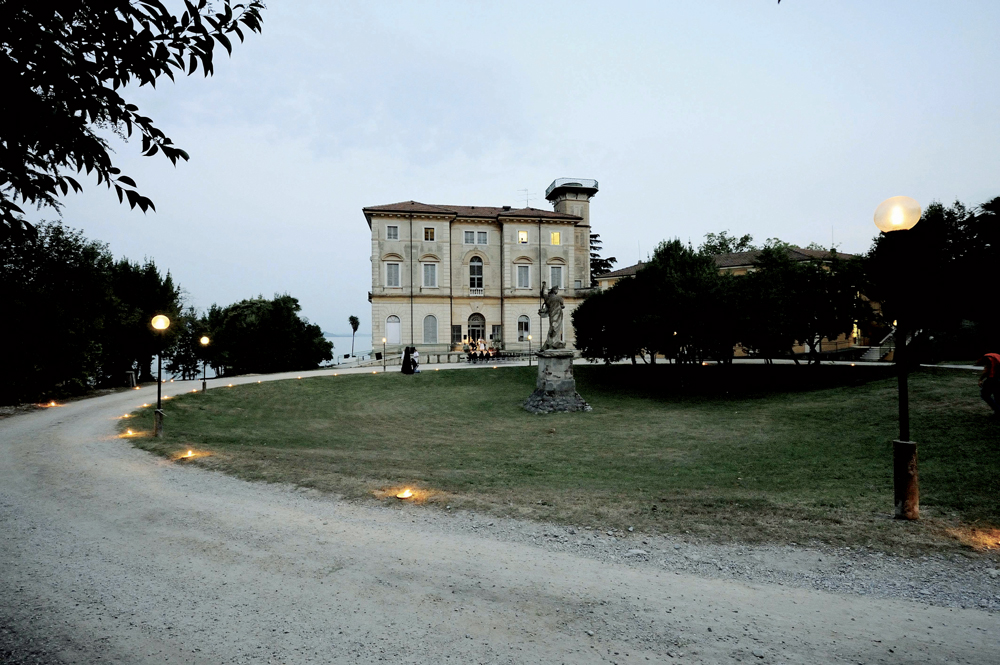
On the border with Fasano, Villa Zanardelli was built between 1888 and 1892, based on a project of Tagliaferri, for Giuseppe Zanardelli, an important statist, many-times minister of the Regno d’Italian and Prime Minister.
The interior was designed by Ximenes. Zanardelli died here in 1903. It is now a nursing home for disabled owned by a non-profit foundation.
It can be visited on the occasion of public festivals organized by the Foundation'
});
t.setStyle(
new ol.style.Style({
image: new ol.style.Circle({
fill: new ol.style.Fill({
color: '#e7ceb0'
}),
radius: 8,
stroke: new ol.style.Stroke({
color: '#000000',
width: 1,
}),
}),
}),
);
iconList.push(t);
style['745'] = {
'Point': new ol.style.Style({
image: new ol.style.Circle({
fill: new ol.style.Fill({
color: 'rgba(255,255,0,0.6)',
}),
radius: 10,
stroke: new ol.style.Stroke({
color: '#ff0',
width: 1,
}),
}),
}),
'LineString': new ol.style.Style({
stroke: new ol.style.Stroke({
color: '#e7ceb0',
width: 3,
}),
}),
'MultiLineString': new ol.style.Style({
stroke: new ol.style.Stroke({
color: '#e7ceb0',
width: 3,
}),
}),
};
// GPX start
var t = new ol.Feature({
geometry: new ol.geom.Point(ol.proj.fromLonLat([10.61207685763939, 45.63767413608697])),
name: 'Visintini Palace',
description: 'Sumptuous palace in Via Religione that included the monastery complex, already present during the second half of the 13th Century.
The big tower bell and the original planimetry of the church are still visible today'
});
t.setStyle(
new ol.style.Style({
image: new ol.style.Circle({
fill: new ol.style.Fill({
color: '#e7ceb0'
}),
radius: 8,
stroke: new ol.style.Stroke({
color: '#000000',
width: 1,
}),
}),
}),
);
iconList.push(t);
var iconLayer = new ol.layer.Vector({
source: new ol.source.Vector({
features: iconList,
}),
});
vectorList_27.push(iconLayer);
var vectorList_26 = [];
var iconList = [];
style['729'] = {
'Point': new ol.style.Style({
image: new ol.style.Circle({
fill: new ol.style.Fill({
color: 'rgba(255,255,0,0.6)',
}),
radius: 10,
stroke: new ol.style.Stroke({
color: '#ff0',
width: 1,
}),
}),
}),
'LineString': new ol.style.Style({
stroke: new ol.style.Stroke({
color: '#3aa25f',
width: 3,
}),
}),
'MultiLineString': new ol.style.Style({
stroke: new ol.style.Stroke({
color: '#3aa25f',
width: 3,
}),
}),
};
// GPX start
var t = new ol.Feature({
geometry: new ol.geom.Point(ol.proj.fromLonLat([10.612287685199416, 45.64235109740499])),
name: 'Bernini Park',
description: 'Situated in the historical centre of Toscolano, there is the biggest tree of the lake; a majestic himalayan cedar tree with a trank of more than 2 m diameter, together with two munumental cedars of Lebanon'
});
t.setStyle(
new ol.style.Style({
image: new ol.style.Circle({
fill: new ol.style.Fill({
color: '#3aa25f'
}),
radius: 8,
stroke: new ol.style.Stroke({
color: '#000000',
width: 1,
}),
}),
}),
);
iconList.push(t);
style['777'] = {
'Point': new ol.style.Style({
image: new ol.style.Circle({
fill: new ol.style.Fill({
color: 'rgba(255,255,0,0.6)',
}),
radius: 10,
stroke: new ol.style.Stroke({
color: '#ff0',
width: 1,
}),
}),
}),
'LineString': new ol.style.Style({
stroke: new ol.style.Stroke({
color: '#3aa25f',
width: 3,
}),
}),
'MultiLineString': new ol.style.Style({
stroke: new ol.style.Stroke({
color: '#3aa25f',
width: 3,
}),
}),
};
// GPX start
var t = new ol.Feature({
geometry: new ol.geom.Point(ol.proj.fromLonLat([10.563222671306473, 45.67578248657453])),
name: 'Exhibition point Passo Spino',
description: '
'
});
t.setStyle(
new ol.style.Style({
image: new ol.style.Circle({
fill: new ol.style.Fill({
color: '#3aa25f'
}),
radius: 8,
stroke: new ol.style.Stroke({
color: '#000000',
width: 1,
}),
}),
}),
);
iconList.push(t);
style['721'] = {
'Point': new ol.style.Style({
image: new ol.style.Circle({
fill: new ol.style.Fill({
color: 'rgba(255,255,0,0.6)',
}),
radius: 10,
stroke: new ol.style.Stroke({
color: '#ff0',
width: 1,
}),
}),
}),
'LineString': new ol.style.Style({
stroke: new ol.style.Stroke({
color: '#3aa25f',
width: 3,
}),
}),
'MultiLineString': new ol.style.Style({
stroke: new ol.style.Stroke({
color: '#3aa25f',
width: 3,
}),
}),
};
// GPX start
var t = new ol.Feature({
geometry: new ol.geom.Point(ol.proj.fromLonLat([10.611458300543886, 45.63881621247144])),
name: 'The Botanic Garden \"Ghirardi\"',
description: 'The garden was open in 1964 as Agricultural Experiment Station of the pharmaceutical company SIMES, wanted by its owner Giordano Emilio Ghirardi, in order to study medicinal plants from all over the world. In 1991 the garden was donated to the Università degli Studi di Milano and it is now run by the Biology Department. The plants of different origin here cultivated are chosen based on their medical interest and indigenous plants for the realisation of project in cooperation with the Comunità Montana Parco Alto Garda Bresciano in order to study the flora of the territory. The Garden is also the location of didactic avtivities, it’s partner of international cooperation such as with the Botanical garden in Valencia, for research, exchange and students visits. Sesasonal openings organised by the University
Info: orto.ghirardi@unimi.it
Info www.unimi.it'
});
t.setStyle(
new ol.style.Style({
image: new ol.style.Circle({
fill: new ol.style.Fill({
color: '#3aa25f'
}),
radius: 8,
stroke: new ol.style.Stroke({
color: '#000000',
width: 1,
}),
}),
}),
);
iconList.push(t);
style['707'] = {
'Point': new ol.style.Style({
image: new ol.style.Circle({
fill: new ol.style.Fill({
color: 'rgba(255,255,0,0.6)',
}),
radius: 10,
stroke: new ol.style.Stroke({
color: '#ff0',
width: 1,
}),
}),
}),
'LineString': new ol.style.Style({
stroke: new ol.style.Stroke({
color: '#3aa25f',
width: 3,
}),
}),
'MultiLineString': new ol.style.Style({
stroke: new ol.style.Stroke({
color: '#3aa25f',
width: 3,
}),
}),
};
// GPX start
var t = new ol.Feature({
geometry: new ol.geom.Point(ol.proj.fromLonLat([10.604170415888738, 45.64972537665636])),
name: 'The Paper Museum',
description: '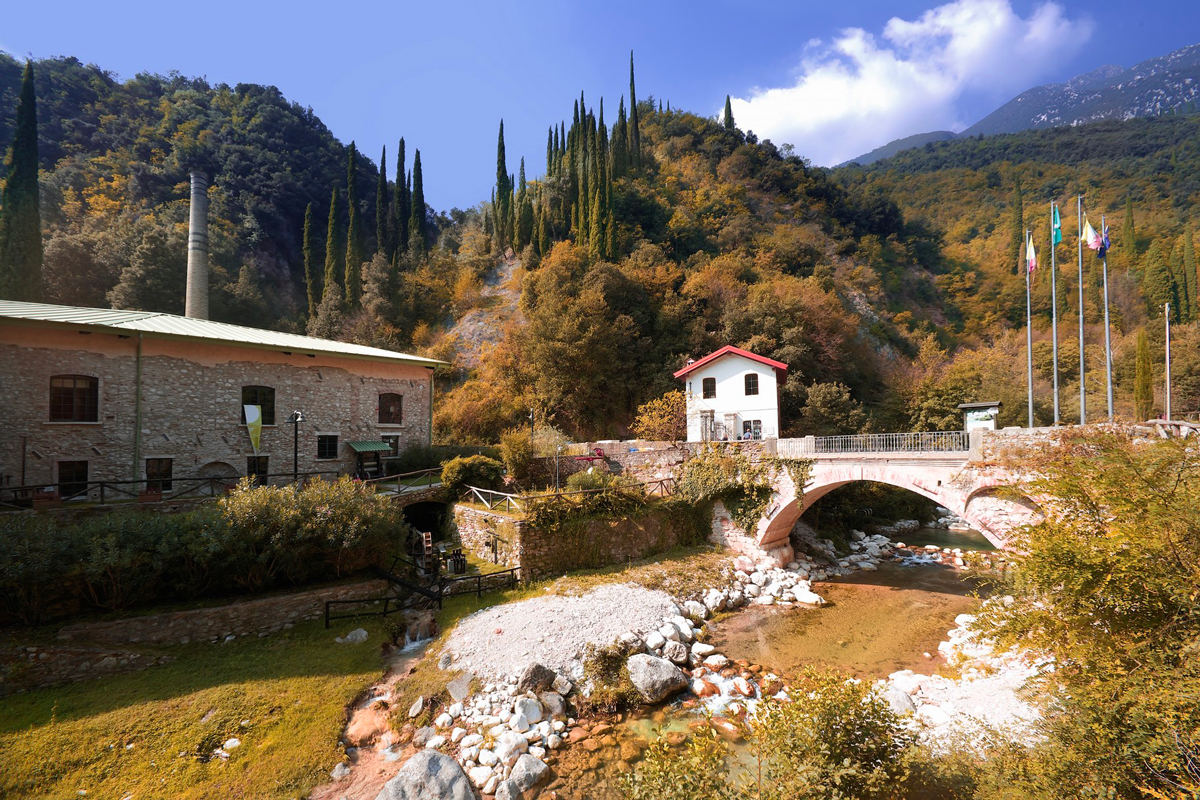
The paper production centre in Maina Inferiore is a fascinating productive complex transformed in museum. The museum recalls the different phases of paper production from the Middle age to the 20th Century, through an evocative path from the 16th Century nucleus of the mill, where visitors find reproductions of machinery and instruments typical of paper production from 15th to 18th Century to the upper rooms dedicated to the evolution of paper production during the early phases of the Industrial Revolution. In exhibition there are also some findings from the archaeological excavations carried out in the Paper Mill Valley, some watermarks produced between the 16th and 18th Century, and a collection of books printed by the Paganinis, illustrious publishers who owned a print shop in Toscolano and Venice during the first half of the 16th Century. Besides guided tours and didactic workshops about the history of paper, The Centre organises cultural events and exhibitions.
Info
www.valledellecartiere.it '
});
t.setStyle(
new ol.style.Style({
image: new ol.style.Circle({
fill: new ol.style.Fill({
color: '#3aa25f'
}),
radius: 8,
stroke: new ol.style.Stroke({
color: '#000000',
width: 1,
}),
}),
}),
);
iconList.push(t);
style['717'] = {
'Point': new ol.style.Style({
image: new ol.style.Circle({
fill: new ol.style.Fill({
color: 'rgba(255,255,0,0.6)',
}),
radius: 10,
stroke: new ol.style.Stroke({
color: '#ff0',
width: 1,
}),
}),
}),
'LineString': new ol.style.Style({
stroke: new ol.style.Stroke({
color: '#3aa25f',
width: 3,
}),
}),
'MultiLineString': new ol.style.Style({
stroke: new ol.style.Stroke({
color: '#3aa25f',
width: 3,
}),
}),
};
// GPX start
var t = new ol.Feature({
geometry: new ol.geom.Point(ol.proj.fromLonLat([10.61828302752718, 45.643419392202766])),
name: 'The Roman Villa',
description: '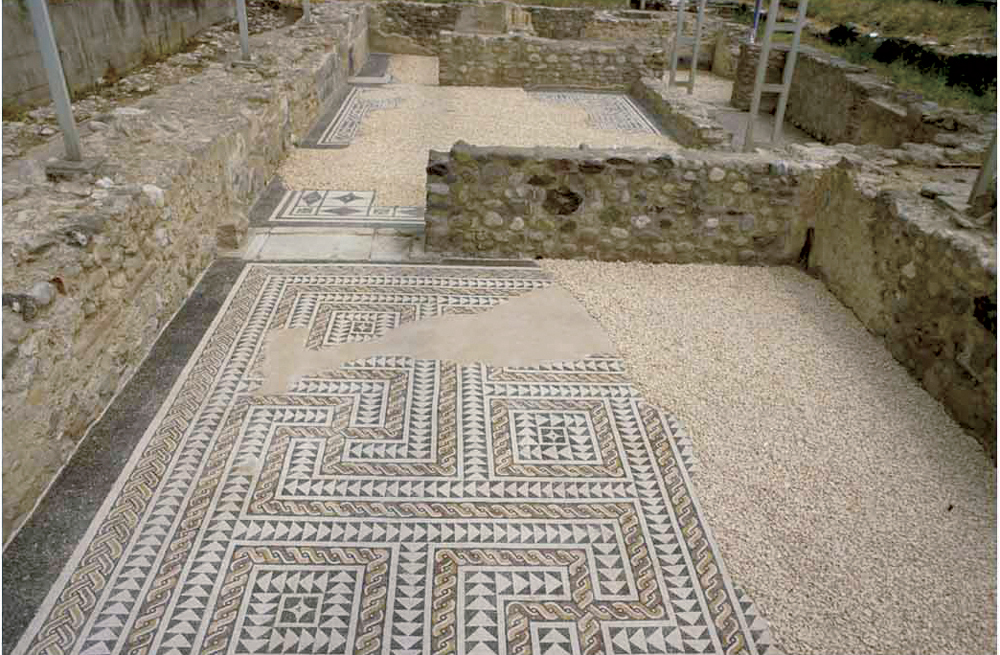
One of the most important residential building of the Lake Garda shore built during the roman period. The main part of the complex faced the lake. Due to the plan, the size, the architectural and decorative features, it is part of the lake villas that once existed on the Benacus shore, like the villa in Sirmione and Desenzano del Garda.
The villa probably belonged to the Nonii, one of the mos important brescian families that had a lot of economic business and properties in the lake and country area. Thanks to an inscription the Villa is attributed toMarcus Nonius Macrinus, consul in 154, proconsul of Asia in 170-171, legatus and comes for the Emperor Marcus Aurelius. The sector that is currently visible it’s th southern one, called sector A, that was one of the side wing of the building. Here are several rooms, some of them with mosaic floors and up to 1 m high painted walls.
Opening times: May - September on saturday and sunday (10-12, 3pm-6pm). Free entry
Info 0365-546023'
});
t.setStyle(
new ol.style.Style({
image: new ol.style.Circle({
fill: new ol.style.Fill({
color: '#3aa25f'
}),
radius: 8,
stroke: new ol.style.Stroke({
color: '#000000',
width: 1,
}),
}),
}),
);
iconList.push(t);
var iconLayer = new ol.layer.Vector({
source: new ol.source.Vector({
features: iconList,
}),
});
vectorList_26.push(iconLayer);
var vectorList_25 = [];
var iconList = [];
style['704'] = {
'Point': new ol.style.Style({
image: new ol.style.Circle({
fill: new ol.style.Fill({
color: 'rgba(255,255,0,0.6)',
}),
radius: 10,
stroke: new ol.style.Stroke({
color: '#ff0',
width: 1,
}),
}),
}),
'LineString': new ol.style.Style({
stroke: new ol.style.Stroke({
color: '#ff0000',
width: 3,
}),
}),
'MultiLineString': new ol.style.Style({
stroke: new ol.style.Stroke({
color: '#ff0000',
width: 3,
}),
}),
};
// GPX start
var t = new ol.Feature({
geometry: new ol.geom.Point(ol.proj.fromLonLat([10.610403592871567, 45.63624550167299])),
name: 'Bonaspetti villa',
description: 'Seat of the Independent Republican Police Department composed of local auxiliary officers'
});
t.setStyle(
new ol.style.Style({
image: new ol.style.Circle({
fill: new ol.style.Fill({
color: '#ff0000'
}),
radius: 8,
stroke: new ol.style.Stroke({
color: '#000000',
width: 1,
}),
}),
}),
);
iconList.push(t);
style['769'] = {
'Point': new ol.style.Style({
image: new ol.style.Circle({
fill: new ol.style.Fill({
color: 'rgba(255,255,0,0.6)',
}),
radius: 10,
stroke: new ol.style.Stroke({
color: '#ff0',
width: 1,
}),
}),
}),
'LineString': new ol.style.Style({
stroke: new ol.style.Stroke({
color: '#ff0000',
width: 3,
}),
}),
'MultiLineString': new ol.style.Style({
stroke: new ol.style.Stroke({
color: '#ff0000',
width: 3,
}),
}),
};
// GPX start
var t = new ol.Feature({
geometry: new ol.geom.Point(ol.proj.fromLonLat([10.586185, 45.626012])),
name: 'Ex Villa Bassetti',
description: 'It was the seat of the German Embassy, bombed by the Allied on 4th december 1944. It is now a condominium, on the border with Gardone Riviera
'
});
t.setStyle(
new ol.style.Style({
image: new ol.style.Circle({
fill: new ol.style.Fill({
color: '#ff0000'
}),
radius: 8,
stroke: new ol.style.Stroke({
color: '#000000',
width: 1,
}),
}),
}),
);
iconList.push(t);
style['728'] = {
'Point': new ol.style.Style({
image: new ol.style.Circle({
fill: new ol.style.Fill({
color: 'rgba(255,255,0,0.6)',
}),
radius: 10,
stroke: new ol.style.Stroke({
color: '#ff0',
width: 1,
}),
}),
}),
'LineString': new ol.style.Style({
stroke: new ol.style.Stroke({
color: '#ff0000',
width: 3,
}),
}),
'MultiLineString': new ol.style.Style({
stroke: new ol.style.Stroke({
color: '#ff0000',
width: 3,
}),
}),
};
// GPX start
var t = new ol.Feature({
geometry: new ol.geom.Point(ol.proj.fromLonLat([10.60751875636301, 45.631131027445676])),
name: 'Ex Villa Cavallero',
description: 'On the lakeshore of Maderno, it was used by Alessandro Pavolini, Secretary of the new Republican Fascist Party
'
});
t.setStyle(
new ol.style.Style({
image: new ol.style.Circle({
fill: new ol.style.Fill({
color: '#ff0000'
}),
radius: 8,
stroke: new ol.style.Stroke({
color: '#000000',
width: 1,
}),
}),
}),
);
iconList.push(t);
style['743'] = {
'Point': new ol.style.Style({
image: new ol.style.Circle({
fill: new ol.style.Fill({
color: 'rgba(255,255,0,0.6)',
}),
radius: 10,
stroke: new ol.style.Stroke({
color: '#ff0',
width: 1,
}),
}),
}),
'LineString': new ol.style.Style({
stroke: new ol.style.Stroke({
color: '#ff0000',
width: 3,
}),
}),
'MultiLineString': new ol.style.Style({
stroke: new ol.style.Stroke({
color: '#ff0000',
width: 3,
}),
}),
};
// GPX start
var t = new ol.Feature({
geometry: new ol.geom.Point(ol.proj.fromLonLat([10.605147687404417, 45.631533160092985])),
name: 'Hotel Bristol',
description: 'This big building was built at the end of the 1800 and named Villa Margherita. In 1909 became the Strand Hotel Bristol, where kids affected by tubercolosis used to stay during the holidays
Frim 1943 to 1945 was used by Mussolini\'s collaborators
'
});
t.setStyle(
new ol.style.Style({
image: new ol.style.Circle({
fill: new ol.style.Fill({
color: '#ff0000'
}),
radius: 8,
stroke: new ol.style.Stroke({
color: '#000000',
width: 1,
}),
}),
}),
);
iconList.push(t);
style['720'] = {
'Point': new ol.style.Style({
image: new ol.style.Circle({
fill: new ol.style.Fill({
color: 'rgba(255,255,0,0.6)',
}),
radius: 10,
stroke: new ol.style.Stroke({
color: '#ff0',
width: 1,
}),
}),
}),
'LineString': new ol.style.Style({
stroke: new ol.style.Stroke({
color: '#ff0000',
width: 3,
}),
}),
'MultiLineString': new ol.style.Style({
stroke: new ol.style.Stroke({
color: '#ff0000',
width: 3,
}),
}),
};
// GPX start
var t = new ol.Feature({
geometry: new ol.geom.Point(ol.proj.fromLonLat([10.598209055538318, 45.635834449091774])),
name: 'Hotel Golfo - Ex Villa Bianchi',
description: '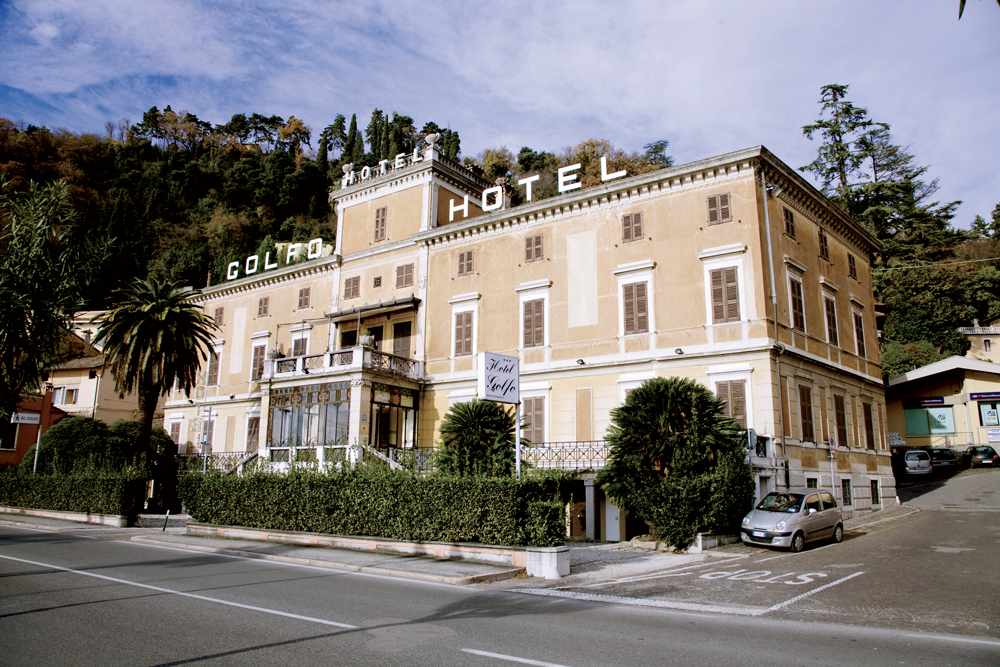
Villa Bianchi, now Hotel Golfo, was built in XVIII C. and modernised in 1894 when the tower and the decorations in liberty style were added. It has been the residence of the mayor of Maderno, Cav. Giovan battista Bianchi, until 1940s. Between 1943 and 1945 it was occupied and was the seat of the Republican Fascist Party and the headquarters of the Black Brigades. It was then property of the Piva Family, that opened the Hotel Palace, then Hotel Golfo. Inside, in 1942 Angelo Landi from Salò made beautiful paintings representing the legend of Engardina, the nymph who gave the blu of her hair to the lake Benaco.'
});
t.setStyle(
new ol.style.Style({
image: new ol.style.Circle({
fill: new ol.style.Fill({
color: '#ff0000'
}),
radius: 8,
stroke: new ol.style.Stroke({
color: '#000000',
width: 1,
}),
}),
}),
);
iconList.push(t);
style['702'] = {
'Point': new ol.style.Style({
image: new ol.style.Circle({
fill: new ol.style.Fill({
color: 'rgba(255,255,0,0.6)',
}),
radius: 10,
stroke: new ol.style.Stroke({
color: '#ff0',
width: 1,
}),
}),
}),
'LineString': new ol.style.Style({
stroke: new ol.style.Stroke({
color: '#ff0000',
width: 3,
}),
}),
'MultiLineString': new ol.style.Style({
stroke: new ol.style.Stroke({
color: '#ff0000',
width: 3,
}),
}),
};
// GPX start
var t = new ol.Feature({
geometry: new ol.geom.Point(ol.proj.fromLonLat([10.61239851564997, 45.63783494256213])),
name: 'Toscolano Camping',
description: 'The military company of the Italian Social republic was set against the boundary wall, where now there are the tennis courts'
});
t.setStyle(
new ol.style.Style({
image: new ol.style.Circle({
fill: new ol.style.Fill({
color: '#ff0000'
}),
radius: 8,
stroke: new ol.style.Stroke({
color: '#000000',
width: 1,
}),
}),
}),
);
iconList.push(t);
style['734'] = {
'Point': new ol.style.Style({
image: new ol.style.Circle({
fill: new ol.style.Fill({
color: 'rgba(255,255,0,0.6)',
}),
radius: 10,
stroke: new ol.style.Stroke({
color: '#ff0',
width: 1,
}),
}),
}),
'LineString': new ol.style.Style({
stroke: new ol.style.Stroke({
color: '#ff0000',
width: 3,
}),
}),
'MultiLineString': new ol.style.Style({
stroke: new ol.style.Stroke({
color: '#ff0000',
width: 3,
}),
}),
};
// GPX start
var t = new ol.Feature({
geometry: new ol.geom.Point(ol.proj.fromLonLat([10.600364283408126, 45.638163897913664])),
name: 'Villa Caprera',
description: 'It was the seat of the Republican National Guard and prison for many antifascist
'
});
t.setStyle(
new ol.style.Style({
image: new ol.style.Circle({
fill: new ol.style.Fill({
color: '#ff0000'
}),
radius: 8,
stroke: new ol.style.Stroke({
color: '#000000',
width: 1,
}),
}),
}),
);
iconList.push(t);
style['742'] = {
'Point': new ol.style.Style({
image: new ol.style.Circle({
fill: new ol.style.Fill({
color: 'rgba(255,255,0,0.6)',
}),
radius: 10,
stroke: new ol.style.Stroke({
color: '#ff0',
width: 1,
}),
}),
}),
'LineString': new ol.style.Style({
stroke: new ol.style.Stroke({
color: '#ff0000',
width: 3,
}),
}),
'MultiLineString': new ol.style.Style({
stroke: new ol.style.Stroke({
color: '#ff0000',
width: 3,
}),
}),
};
// GPX start
var t = new ol.Feature({
geometry: new ol.geom.Point(ol.proj.fromLonLat([10.594556697785693, 45.63452885780726])),
name: 'Villa Gemma',
description: 'Maderno (Via Roma). It belonged to the Triboldi family and here the INTERNO Minister Buffarini and the Ministero f National Education Biggini were hosted. '
});
t.setStyle(
new ol.style.Style({
image: new ol.style.Circle({
fill: new ol.style.Fill({
color: '#ff0000'
}),
radius: 8,
stroke: new ol.style.Stroke({
color: '#000000',
width: 1,
}),
}),
}),
);
iconList.push(t);
style['738'] = {
'Point': new ol.style.Style({
image: new ol.style.Circle({
fill: new ol.style.Fill({
color: 'rgba(255,255,0,0.6)',
}),
radius: 10,
stroke: new ol.style.Stroke({
color: '#ff0',
width: 1,
}),
}),
}),
'LineString': new ol.style.Style({
stroke: new ol.style.Stroke({
color: '#ff0000',
width: 3,
}),
}),
'MultiLineString': new ol.style.Style({
stroke: new ol.style.Stroke({
color: '#ff0000',
width: 3,
}),
}),
};
// GPX start
var t = new ol.Feature({
geometry: new ol.geom.Point(ol.proj.fromLonLat([10.597948162553598, 45.6361958034773])),
name: 'Villa Serenella',
description: 'The Consul of the militia G. Battista Riggio, one of the members of the special Jury in Verona that sentenced Galeazzo Ciano and others to death, lived in this villa
'
});
t.setStyle(
new ol.style.Style({
image: new ol.style.Circle({
fill: new ol.style.Fill({
color: '#ff0000'
}),
radius: 8,
stroke: new ol.style.Stroke({
color: '#000000',
width: 1,
}),
}),
}),
);
iconList.push(t);
var iconLayer = new ol.layer.Vector({
source: new ol.source.Vector({
features: iconList,
}),
});
vectorList_25.push(iconLayer);
var vectorList_37 = [];
var iconList = [];
style['772'] = {
'Point': new ol.style.Style({
image: new ol.style.Circle({
fill: new ol.style.Fill({
color: 'rgba(255,255,0,0.6)',
}),
radius: 10,
stroke: new ol.style.Stroke({
color: '#ff0',
width: 1,
}),
}),
}),
'LineString': new ol.style.Style({
stroke: new ol.style.Stroke({
color: '#a28b3a',
width: 3,
}),
}),
'MultiLineString': new ol.style.Style({
stroke: new ol.style.Stroke({
color: '#a28b3a',
width: 3,
}),
}),
};
// GPX start
var t = new ol.Feature({
geometry: new ol.geom.Point(ol.proj.fromLonLat([10.616623024484424, 45.6330071038421])),
name: 'Pedestrian drawbridge',
description: '
'
});
t.setStyle(
new ol.style.Style({
image: new ol.style.Circle({
fill: new ol.style.Fill({
color: '#a28b3a'
}),
radius: 8,
stroke: new ol.style.Stroke({
color: '#000000',
width: 1,
}),
}),
}),
);
iconList.push(t);
var iconLayer = new ol.layer.Vector({
source: new ol.source.Vector({
features: iconList,
}),
});
vectorList_37.push(iconLayer);
var vectorList_24 = [];
var iconList = [];
style['500'] = {
'Point': new ol.style.Style({
image: new ol.style.Circle({
fill: new ol.style.Fill({
color: 'rgba(255,255,0,0.6)',
}),
radius: 10,
stroke: new ol.style.Stroke({
color: '#ff0',
width: 1,
}),
}),
}),
'LineString': new ol.style.Style({
stroke: new ol.style.Stroke({
color: '#be6acd',
width: 3,
}),
}),
'MultiLineString': new ol.style.Style({
stroke: new ol.style.Stroke({
color: '#be6acd',
width: 3,
}),
}),
};
// GPX start
var t = new ol.Feature({
geometry: new ol.geom.Point(ol.proj.fromLonLat([10.599705474709, 45.635790357945])),
name: 'S. Andrea Cathedral',
description: '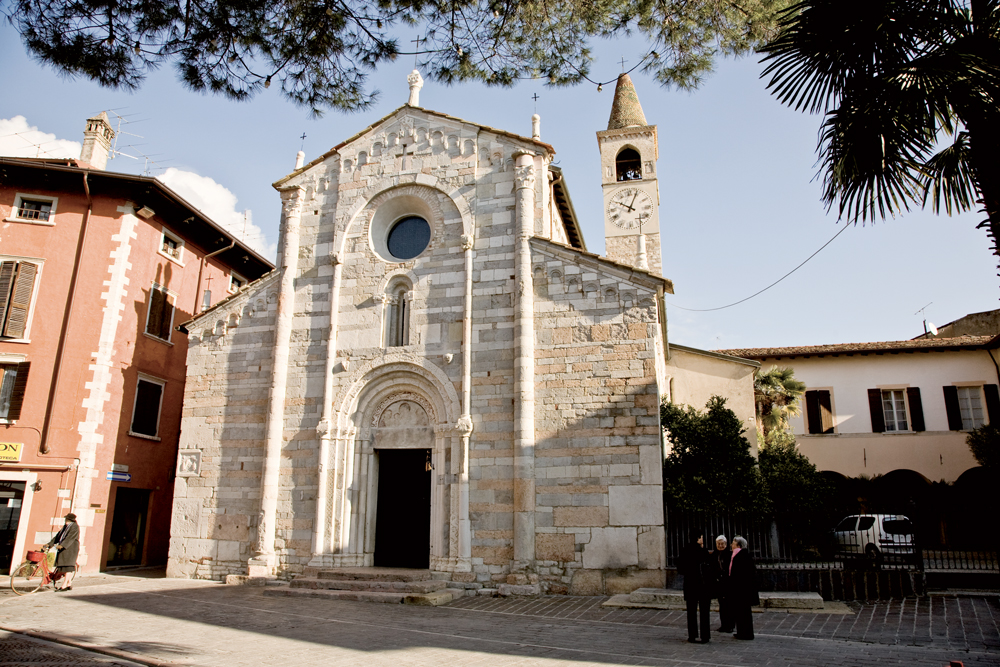
It’s one of the best examples of Lombard-Romanesque architecture influenced by Verona: the façade is masterfully made of stones and polychrome marbles that give light and movement. The inside is divided into 3 aisles by quatrefoil based pillar with capitels representing a wide variety of iconographic decorative motives, typical of the Romanesque style.
Visitors can admire a precious painted board by Paolo Veneziano depicting the Virgin with the Child. The rib vaults of the dom aisles of the chancel date back to the end of the 1400s.
In 1580 Cardinal Borromeo gave the order to close the crypt, that was brought back to light in 1962. Here S. Hercolanus\'s relics were preserved, then moved to the new church in 1825.
'
});
t.setStyle(
new ol.style.Style({
image: new ol.style.Circle({
fill: new ol.style.Fill({
color: '#be6acd'
}),
radius: 8,
stroke: new ol.style.Stroke({
color: '#000000',
width: 1,
}),
}),
}),
);
iconList.push(t);
style['737'] = {
'Point': new ol.style.Style({
image: new ol.style.Circle({
fill: new ol.style.Fill({
color: 'rgba(255,255,0,0.6)',
}),
radius: 10,
stroke: new ol.style.Stroke({
color: '#ff0',
width: 1,
}),
}),
}),
'LineString': new ol.style.Style({
stroke: new ol.style.Stroke({
color: '#be6acd',
width: 3,
}),
}),
'MultiLineString': new ol.style.Style({
stroke: new ol.style.Stroke({
color: '#be6acd',
width: 3,
}),
}),
};
// GPX start
var t = new ol.Feature({
geometry: new ol.geom.Point(ol.proj.fromLonLat([10.599765543738673, 45.63516642642379])),
name: 'S. Andrea\'s Church',
description: '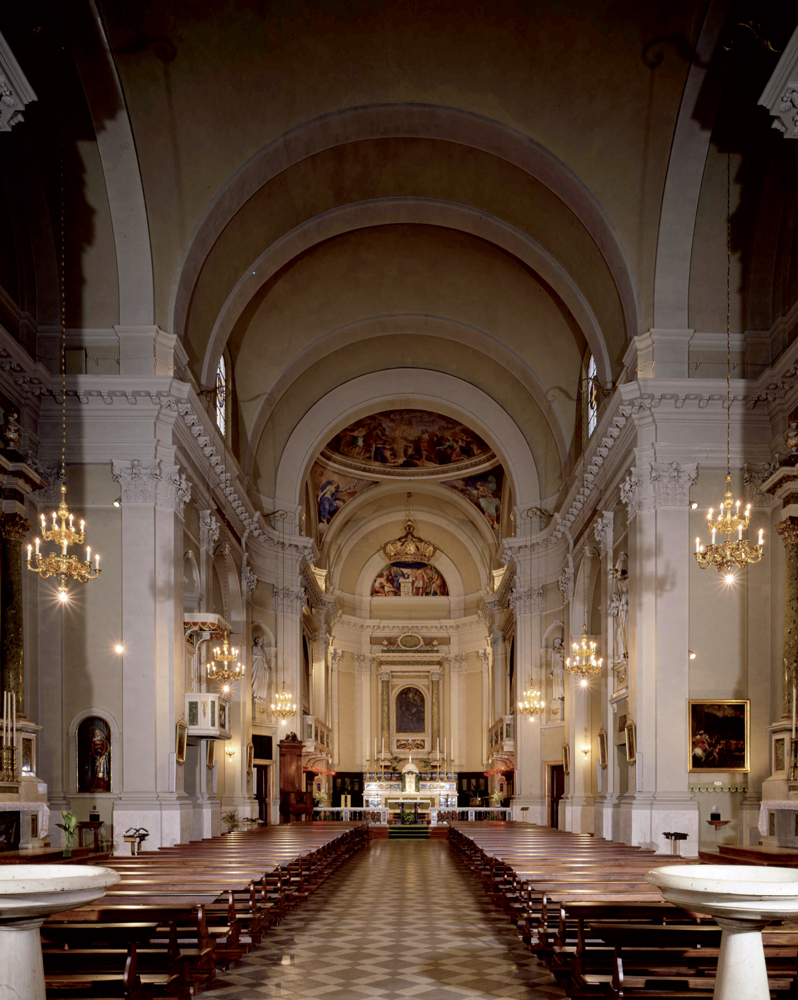
Saint Andrew’s parish church was built during the second half of the XVIII C. where there was once the castle. Its construction was decided in 1742 and it took lots of decades, the church was consacrated in 1825. In this occasion Saint Herculanus’s relics were solemnly moved from the old romanic church to the new parish. The church is a wide building with one aisle. The side chapels, divided by majestic lesenes, have paintings coming from the old parish. On the right side of the aisle there is the altar dedicated to Saint Ercolano that preserves a urne and his relics. The altar is embellished by a painting representing the saint, made by the school of Paolo Caliatri, known as Il Veronese. On the side of the chapel there are two paintings of the beginning of the XVII C. with the Finding of Saint Hercolanus’s body and the Procession of Saint Herculanus’s relics, where it’s possible to recognise the old square with the castle. The altarpiece in the apse represents the Dead Christ with Saint Andrew, made by Francesco Bassano the Young in the second half of the XVI C.'
});
t.setStyle(
new ol.style.Style({
image: new ol.style.Circle({
fill: new ol.style.Fill({
color: '#be6acd'
}),
radius: 8,
stroke: new ol.style.Stroke({
color: '#000000',
width: 1,
}),
}),
}),
);
iconList.push(t);
style['722'] = {
'Point': new ol.style.Style({
image: new ol.style.Circle({
fill: new ol.style.Fill({
color: 'rgba(255,255,0,0.6)',
}),
radius: 10,
stroke: new ol.style.Stroke({
color: '#ff0',
width: 1,
}),
}),
}),
'LineString': new ol.style.Style({
stroke: new ol.style.Stroke({
color: '#be6acd',
width: 3,
}),
}),
'MultiLineString': new ol.style.Style({
stroke: new ol.style.Stroke({
color: '#be6acd',
width: 3,
}),
}),
};
// GPX start
var t = new ol.Feature({
geometry: new ol.geom.Point(ol.proj.fromLonLat([10.600096564629, 45.64535393265])),
name: 'S. Martino\'s Church',
description: '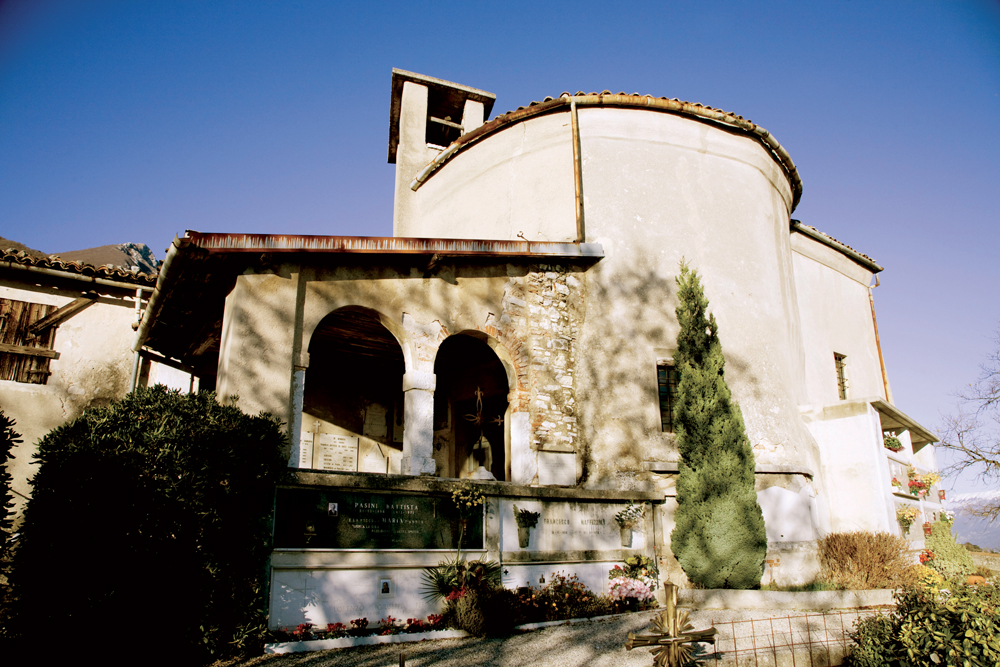
Close to the district of Sanico, in Prati di San Martino, the small San Martino di Tours’s church was built on an isolated hill near the ravine of the Toscolano river. It was used as lazaretto since the beginning of the 17th Century. The adjacent cemetery hosted the deceased of Maderno and its districts until the end of the 19th Century. It’s a circular church with a rectangular apse. Next to the church there is a small residential building dating back to the 17th Century (see the engraving on the wall) when a hermit used to live here. The original nucleus is the circular building that is now the aisle, and that was supposed to have a small apse east and a pronaos west.'
});
t.setStyle(
new ol.style.Style({
image: new ol.style.Circle({
fill: new ol.style.Fill({
color: '#be6acd'
}),
radius: 8,
stroke: new ol.style.Stroke({
color: '#000000',
width: 1,
}),
}),
}),
);
iconList.push(t);
style['711'] = {
'Point': new ol.style.Style({
image: new ol.style.Circle({
fill: new ol.style.Fill({
color: 'rgba(255,255,0,0.6)',
}),
radius: 10,
stroke: new ol.style.Stroke({
color: '#ff0',
width: 1,
}),
}),
}),
'LineString': new ol.style.Style({
stroke: new ol.style.Stroke({
color: '#be6acd',
width: 3,
}),
}),
'MultiLineString': new ol.style.Style({
stroke: new ol.style.Stroke({
color: '#be6acd',
width: 3,
}),
}),
};
// GPX start
var t = new ol.Feature({
geometry: new ol.geom.Point(ol.proj.fromLonLat([10.616715872936, 45.65003075128])),
name: 'S. Michele\'s Church',
description: '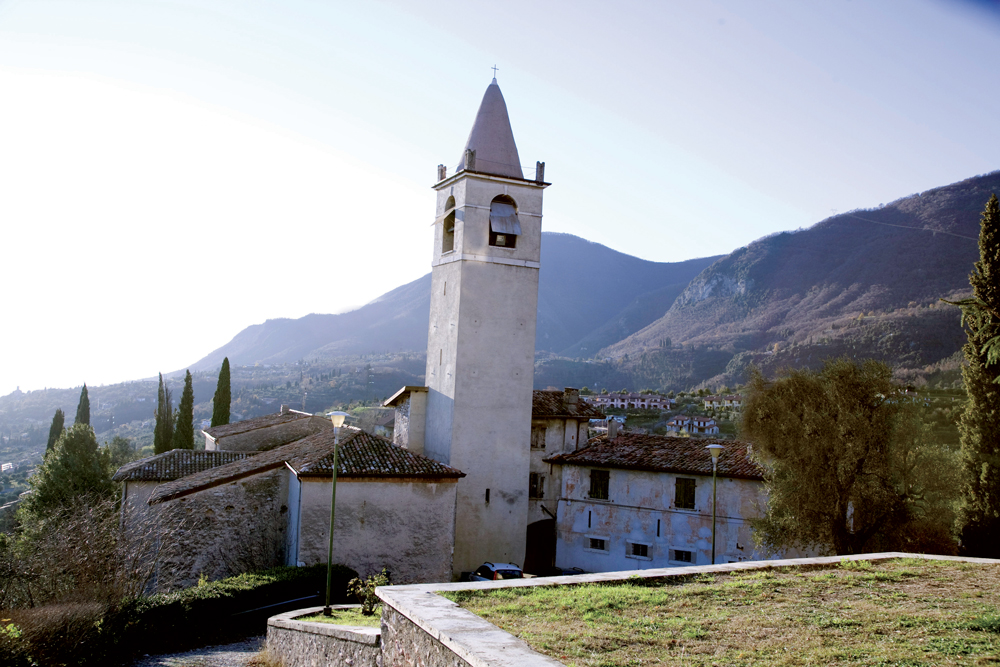
The old parish church dates back to the 15th Century and it’s right in front of the new parish. Probably built on the ruins of an old fortalice, documented as castellum (castle) in the Middle Ages. San Michele was the main saint for the Longobards. The tower bell looks like a defence tower, at its base there is a “recycled” roman inscription recalling Antoninus Pius and Marcus Aurelius. The portico dates back to the 16th C The church had 3 altars dedicated to San Michele, San Rocco and the Trinity, it was surrounded by a cemetery, a rectory and a rural house. It is now seat of meetings and offices.'
});
t.setStyle(
new ol.style.Style({
image: new ol.style.Circle({
fill: new ol.style.Fill({
color: '#be6acd'
}),
radius: 8,
stroke: new ol.style.Stroke({
color: '#000000',
width: 1,
}),
}),
}),
);
iconList.push(t);
style['712'] = {
'Point': new ol.style.Style({
image: new ol.style.Circle({
fill: new ol.style.Fill({
color: 'rgba(255,255,0,0.6)',
}),
radius: 10,
stroke: new ol.style.Stroke({
color: '#ff0',
width: 1,
}),
}),
}),
'LineString': new ol.style.Style({
stroke: new ol.style.Stroke({
color: '#be6acd',
width: 3,
}),
}),
'MultiLineString': new ol.style.Style({
stroke: new ol.style.Stroke({
color: '#be6acd',
width: 3,
}),
}),
};
// GPX start
var t = new ol.Feature({
geometry: new ol.geom.Point(ol.proj.fromLonLat([10.630855041267, 45.656695606253])),
name: 'S. Nicola\'s Church',
description: '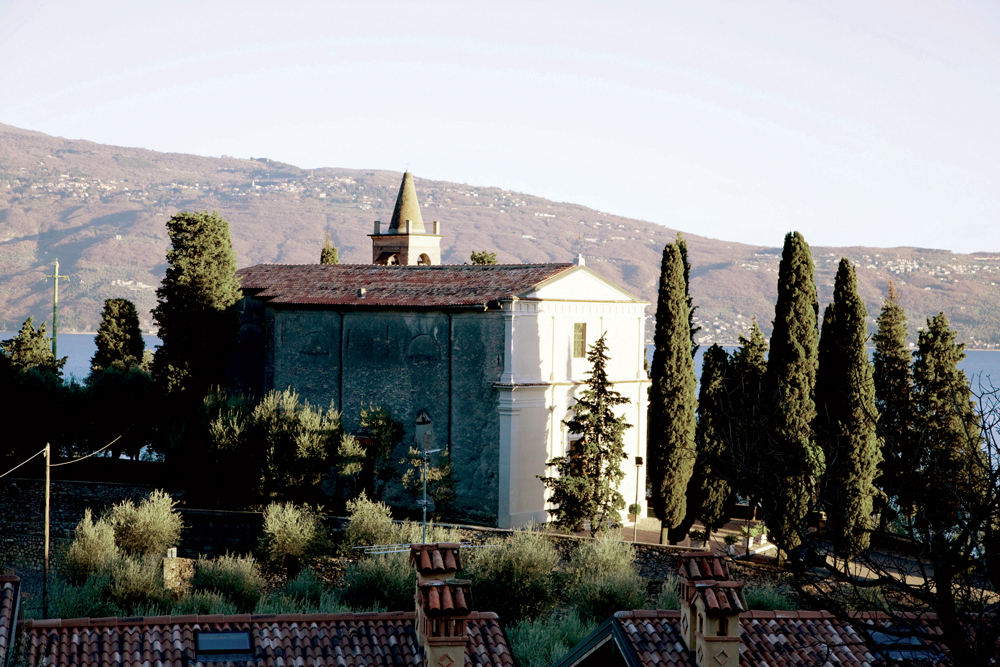
On the top of a hill in Cecina, it\'s a parish church of medieval origin, restored by Pasino Gozio dei Boselli during the 16th Century. The church was enlarged in 1744 adding 2 side chapels in front of which there are the tombs of the noble Zuanelli family decorated with their emblem.
The one dedicated to the Virgin and the Child is most sumptuous, and it has a fresco of the XV C. with a baroque stucco frame. On the other side, the altar dedicated to Sant’Alipyus with San Dominic and Filippo Neri was made in 1701, and it preserves a painting of Andrea Celesti (1637-1712 ca). Of the same author the altarpiece closer to the presbitery showing the Stoning of Saint Stephen and Virgin in Glory with Saints, John the Baptist, Lucy and Rock .
There is also a portrait representing a young member of the Boselli family praying an image of San Nicola, attributed to Girolamo Pilotti in the 1500s'
});
t.setStyle(
new ol.style.Style({
image: new ol.style.Circle({
fill: new ol.style.Fill({
color: '#be6acd'
}),
radius: 8,
stroke: new ol.style.Stroke({
color: '#000000',
width: 1,
}),
}),
}),
);
iconList.push(t);
style['713'] = {
'Point': new ol.style.Style({
image: new ol.style.Circle({
fill: new ol.style.Fill({
color: 'rgba(255,255,0,0.6)',
}),
radius: 10,
stroke: new ol.style.Stroke({
color: '#ff0',
width: 1,
}),
}),
}),
'LineString': new ol.style.Style({
stroke: new ol.style.Stroke({
color: '#be6acd',
width: 3,
}),
}),
'MultiLineString': new ol.style.Style({
stroke: new ol.style.Stroke({
color: '#be6acd',
width: 3,
}),
}),
};
// GPX start
var t = new ol.Feature({
geometry: new ol.geom.Point(ol.proj.fromLonLat([10.614396139027365, 45.65462032356168])),
name: 'S. Sebastiano\'s Church',
description: '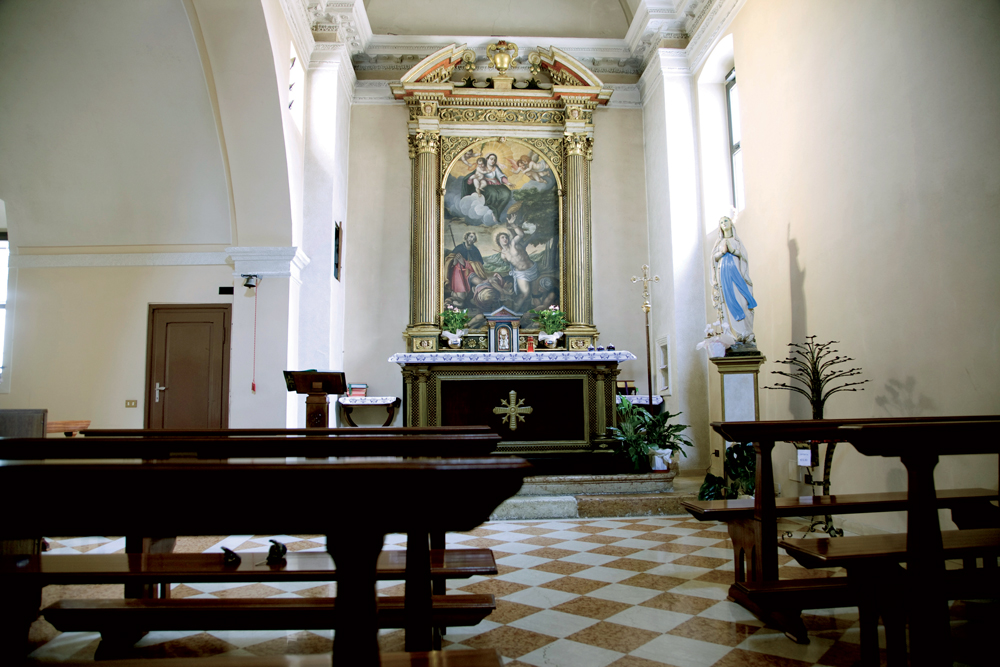
It’s a small church in the middle of Gaino. There aren’t info about the period of its construction.
San Sebastiano, who protects from contagious diseases, is represented with San Rocco and the Virgin
'
});
t.setStyle(
new ol.style.Style({
image: new ol.style.Circle({
fill: new ol.style.Fill({
color: '#be6acd'
}),
radius: 8,
stroke: new ol.style.Stroke({
color: '#000000',
width: 1,
}),
}),
}),
);
iconList.push(t);
style['723'] = {
'Point': new ol.style.Style({
image: new ol.style.Circle({
fill: new ol.style.Fill({
color: 'rgba(255,255,0,0.6)',
}),
radius: 10,
stroke: new ol.style.Stroke({
color: '#ff0',
width: 1,
}),
}),
}),
'LineString': new ol.style.Style({
stroke: new ol.style.Stroke({
color: '#be6acd',
width: 3,
}),
}),
'MultiLineString': new ol.style.Style({
stroke: new ol.style.Stroke({
color: '#be6acd',
width: 3,
}),
}),
};
// GPX start
var t = new ol.Feature({
geometry: new ol.geom.Point(ol.proj.fromLonLat([10.570067005522034, 45.657004753412664])),
name: 'S. Urbano\'s Church',
description: 'The current sacred building was rebuilt in 1928 thanks to Cav. Bianchi, mayor of Maderno, near an older church already existing in the XIV C. that, according to the tradition, was built as sign of devotion for the “lucky escape” from the plague.'
});
t.setStyle(
new ol.style.Style({
image: new ol.style.Circle({
fill: new ol.style.Fill({
color: '#be6acd'
}),
radius: 8,
stroke: new ol.style.Stroke({
color: '#000000',
width: 1,
}),
}),
}),
);
iconList.push(t);
style['724'] = {
'Point': new ol.style.Style({
image: new ol.style.Circle({
fill: new ol.style.Fill({
color: 'rgba(255,255,0,0.6)',
}),
radius: 10,
stroke: new ol.style.Stroke({
color: '#ff0',
width: 1,
}),
}),
}),
'LineString': new ol.style.Style({
stroke: new ol.style.Stroke({
color: '#be6acd',
width: 3,
}),
}),
'MultiLineString': new ol.style.Style({
stroke: new ol.style.Stroke({
color: '#be6acd',
width: 3,
}),
}),
};
// GPX start
var t = new ol.Feature({
geometry: new ol.geom.Point(ol.proj.fromLonLat([10.612592, 45.633150])),
name: 'Santa Maria Immacolata al Promontorio\'s Church',
description: '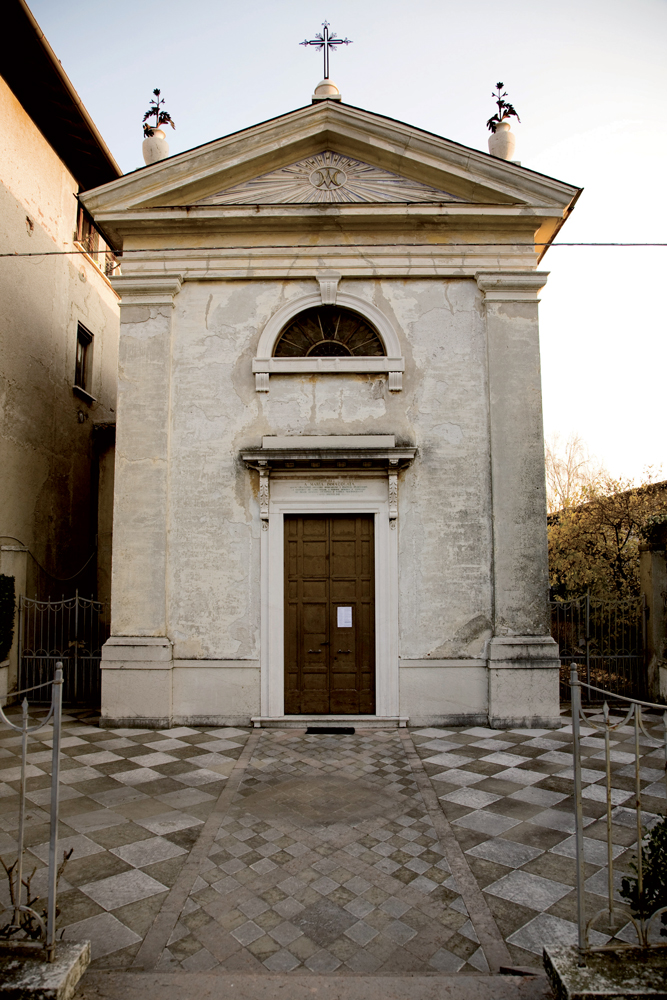
Small oratory, property of the Bonaspetti family. it was built in 1863 by the Franceschini. brothers to commemorate their parents Antonio and Santina
Above the altar, the Virgin with st. Antonio and St. Santina painted by Francesco Podesti
'
});
t.setStyle(
new ol.style.Style({
image: new ol.style.Circle({
fill: new ol.style.Fill({
color: '#be6acd'
}),
radius: 8,
stroke: new ol.style.Stroke({
color: '#000000',
width: 1,
}),
}),
}),
);
iconList.push(t);
style['714'] = {
'Point': new ol.style.Style({
image: new ol.style.Circle({
fill: new ol.style.Fill({
color: 'rgba(255,255,0,0.6)',
}),
radius: 10,
stroke: new ol.style.Stroke({
color: '#ff0',
width: 1,
}),
}),
}),
'LineString': new ol.style.Style({
stroke: new ol.style.Stroke({
color: '#be6acd',
width: 3,
}),
}),
'MultiLineString': new ol.style.Style({
stroke: new ol.style.Stroke({
color: '#be6acd',
width: 3,
}),
}),
};
// GPX start
var t = new ol.Feature({
geometry: new ol.geom.Point(ol.proj.fromLonLat([10.618391662415, 45.64467700808])),
name: 'Santuario di Santa Maria del Benaco',
description: '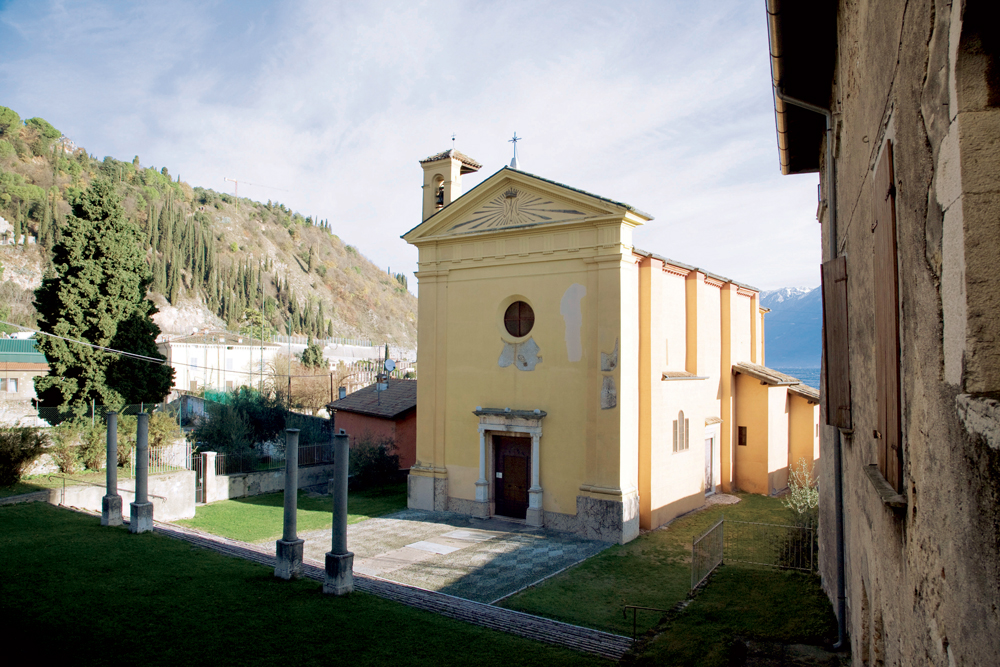
The small Church situated at the back of the parish is dedicated to Santa Maria del Benaco and it boasts very ancient origins. The existing plant, which is rectangular with a single nave, dates back to the XV century. If the external appearance is poor and without decorations, the inside is full of beautiful frescoes dating back to the second half of the 15th century and completed in 1514, representing emblems of the important families that contributed to the restoration of the church and were buried here.
The four columns in the middle of the parvis were part of a medieval or romanic ciborium demolished in 1580 by order of Carlo Borromeo, because the main altar had a pagan capitel representing Jupiter Ammon
During the restoration works in 1829 a mosaic floo came to light, probably it belonged to the Roman Villa
'
});
t.setStyle(
new ol.style.Style({
image: new ol.style.Circle({
fill: new ol.style.Fill({
color: '#be6acd'
}),
radius: 8,
stroke: new ol.style.Stroke({
color: '#000000',
width: 1,
}),
}),
}),
);
iconList.push(t);
style['731'] = {
'Point': new ol.style.Style({
image: new ol.style.Circle({
fill: new ol.style.Fill({
color: 'rgba(255,255,0,0.6)',
}),
radius: 10,
stroke: new ol.style.Stroke({
color: '#ff0',
width: 1,
}),
}),
}),
'LineString': new ol.style.Style({
stroke: new ol.style.Stroke({
color: '#be6acd',
width: 3,
}),
}),
'MultiLineString': new ol.style.Style({
stroke: new ol.style.Stroke({
color: '#be6acd',
width: 3,
}),
}),
};
// GPX start
var t = new ol.Feature({
geometry: new ol.geom.Point(ol.proj.fromLonLat([10.591159272696974, 45.63441476270746])),
name: 'St Faustino and St Giovita\'s Church',
description: '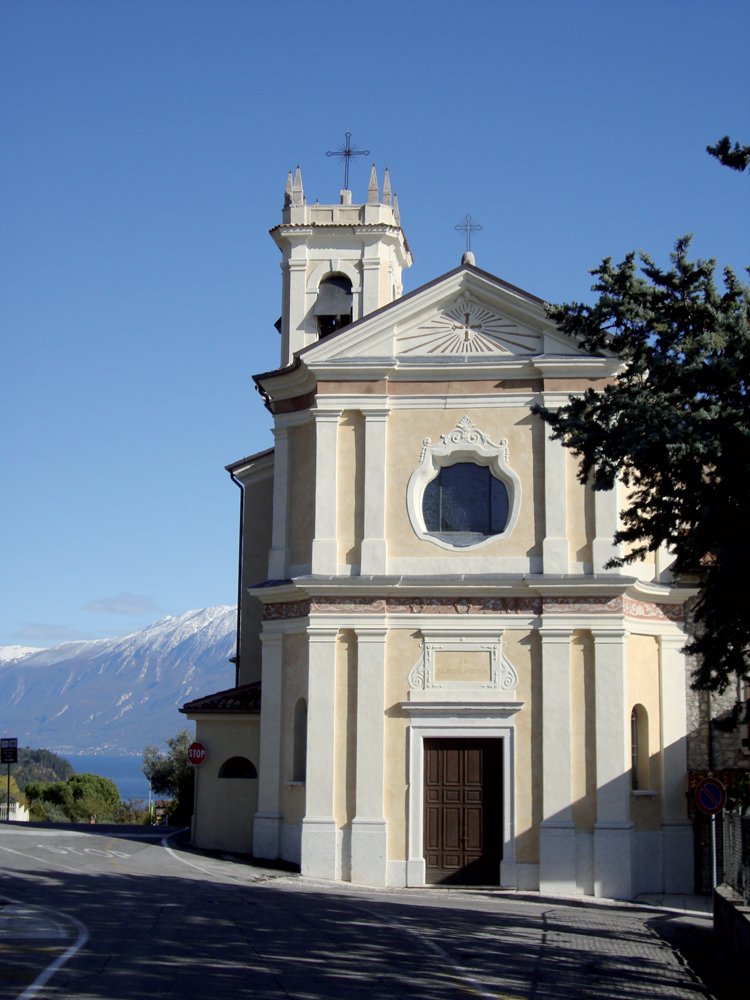
The eighteenth C. Church in Maclino has a unique aisle. The facade is horizontally divided by a gypsum belt course, vertically by twin lesenes supporting the gable. Inside, two side chapels with wooden altars dedicated to the Sacred Heart and to Our Lady of the Rosary. The last one preserves an altarpiece made by Andrea Bertanza from Salò in 1626, it represents the Virgin with Saints Macario and Felicita. On the left of the presbitery there is the canvas of the same author representing the Virgin and the Child with San Carlo Borromeo, Saint Andrew, Saint Herculanus and a benefactor.'
});
t.setStyle(
new ol.style.Style({
image: new ol.style.Circle({
fill: new ol.style.Fill({
color: '#be6acd'
}),
radius: 8,
stroke: new ol.style.Stroke({
color: '#000000',
width: 1,
}),
}),
}),
);
iconList.push(t);
style['725'] = {
'Point': new ol.style.Style({
image: new ol.style.Circle({
fill: new ol.style.Fill({
color: 'rgba(255,255,0,0.6)',
}),
radius: 10,
stroke: new ol.style.Stroke({
color: '#ff0',
width: 1,
}),
}),
}),
'LineString': new ol.style.Style({
stroke: new ol.style.Stroke({
color: '#be6acd',
width: 3,
}),
}),
'MultiLineString': new ol.style.Style({
stroke: new ol.style.Stroke({
color: '#be6acd',
width: 3,
}),
}),
};
// GPX start
var t = new ol.Feature({
geometry: new ol.geom.Point(ol.proj.fromLonLat([10.609422185742, 45.657457385446])),
name: 'St. Filippo and St. Giacomo\'s Church',
description: '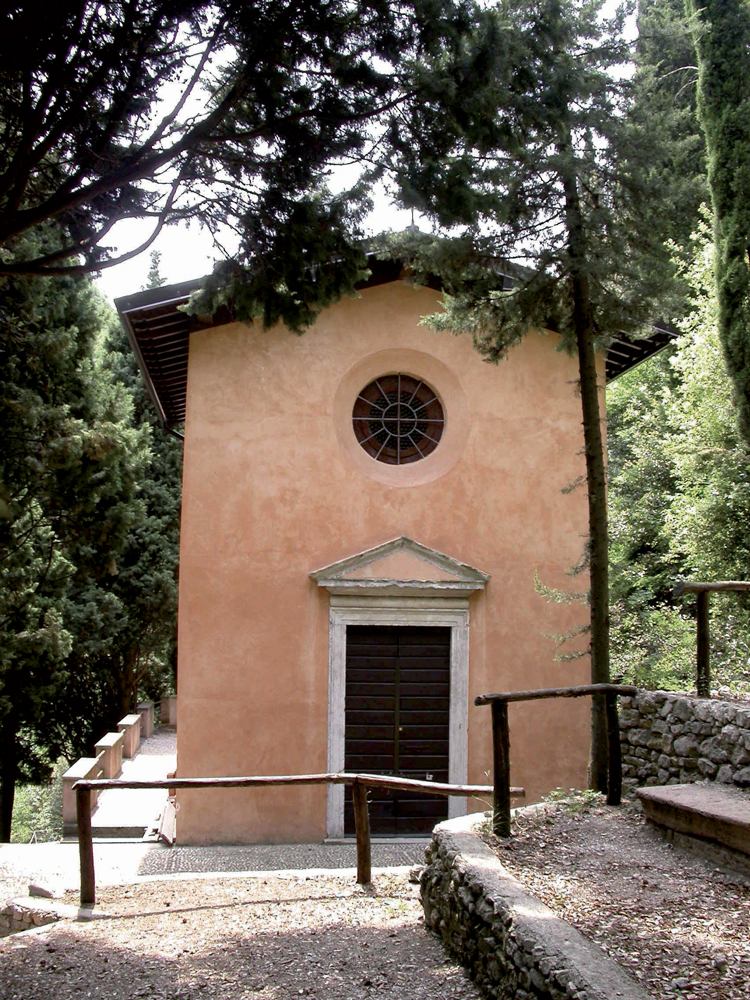
Small chapel realised during the 16th Century by the Tamagnini family. Dedicated to Filippo and Giacomo, protectors of paper makers.
Small and plain structure with beautiful stucco decorations made by Davide Rieti, famous sculptor who worked for the Dome in Salò and fort the Inviolata\'s Curch in Riva del Garda.
Abandoned over a long time, the church has been taken to its original beauty thanks to recent restoration works.
WARNING This part of the valley is temporarily closed
'
});
t.setStyle(
new ol.style.Style({
image: new ol.style.Circle({
fill: new ol.style.Fill({
color: '#be6acd'
}),
radius: 8,
stroke: new ol.style.Stroke({
color: '#000000',
width: 1,
}),
}),
}),
);
iconList.push(t);
style['706'] = {
'Point': new ol.style.Style({
image: new ol.style.Circle({
fill: new ol.style.Fill({
color: 'rgba(255,255,0,0.6)',
}),
radius: 10,
stroke: new ol.style.Stroke({
color: '#ff0',
width: 1,
}),
}),
}),
'LineString': new ol.style.Style({
stroke: new ol.style.Stroke({
color: '#be6acd',
width: 3,
}),
}),
'MultiLineString': new ol.style.Style({
stroke: new ol.style.Stroke({
color: '#be6acd',
width: 3,
}),
}),
};
// GPX start
var t = new ol.Feature({
geometry: new ol.geom.Point(ol.proj.fromLonLat([10.645940182339, 45.66563927187])),
name: 'St. George\'s Church',
description: '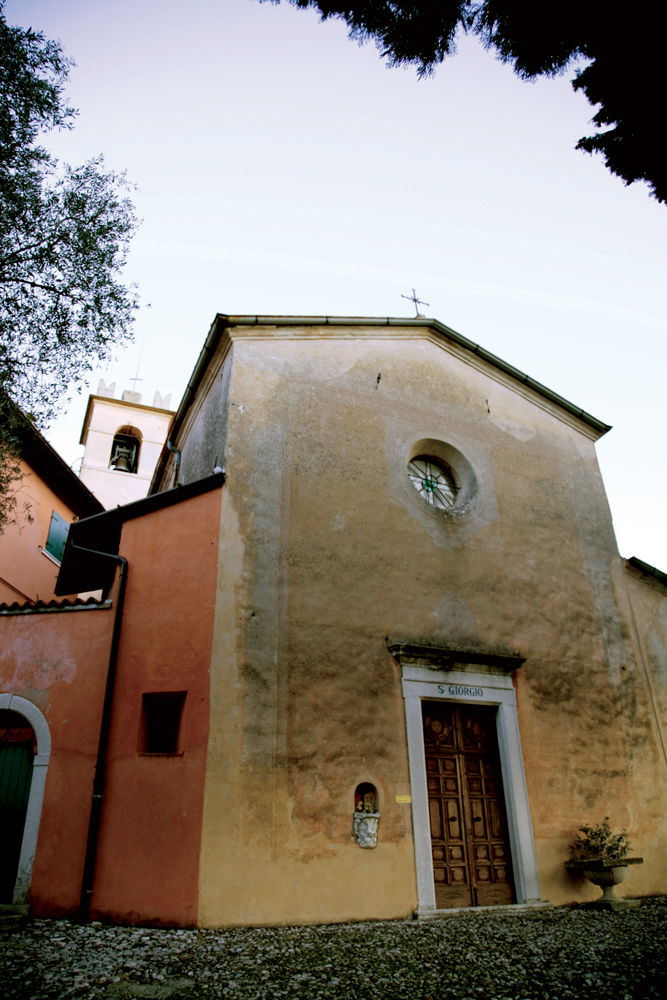
Saint George’s church was founded during the Middle Age, along the ancient royal road, on the top of a hill where the castle of the Pellicani must have been. The façade has a roman corinthian capital. In the apse of the XV C. there is the altarpiece with Saint George slaying the dragon painted by Nicola Grisiani, from Salò, around 1646/47 and a fine altar with polychrome marbles. Under the mensa (tabletop) of the altar there is a roman epigraph dedicated to Lorenia Mercatilla. There are two side altars, one preserves the fine altarpiece with Andrea Celesti’s Piety. The facade of the church was redone during the XVIII C. and completed in 1752 (see the date on the façade). The whole aisle has been repainted during the XX C.'
});
t.setStyle(
new ol.style.Style({
image: new ol.style.Circle({
fill: new ol.style.Fill({
color: '#be6acd'
}),
radius: 8,
stroke: new ol.style.Stroke({
color: '#000000',
width: 1,
}),
}),
}),
);
iconList.push(t);
style['736'] = {
'Point': new ol.style.Style({
image: new ol.style.Circle({
fill: new ol.style.Fill({
color: 'rgba(255,255,0,0.6)',
}),
radius: 10,
stroke: new ol.style.Stroke({
color: '#ff0',
width: 1,
}),
}),
}),
'LineString': new ol.style.Style({
stroke: new ol.style.Stroke({
color: '#be6acd',
width: 3,
}),
}),
'MultiLineString': new ol.style.Style({
stroke: new ol.style.Stroke({
color: '#be6acd',
width: 3,
}),
}),
};
// GPX start
var t = new ol.Feature({
geometry: new ol.geom.Point(ol.proj.fromLonLat([10.560028591989914, 45.69792022216966])),
name: 'St. Mary of the Snows',
description: 'In Campiglio di Cima (mt. 1025) there is a small church entitled to St. Maria della Neve (St. Mary of the Snows) that dates back to 1602. It was built together with the cottage and some other buildings by the Andreoli family, stockmen from Valvestino.
During the XVII Century the church was embellished thanks to Stefania Zambelli from Gaino, who was used to go there everyday, no matter what the weather was like.
The complex is now run by the Alpini'
});
t.setStyle(
new ol.style.Style({
image: new ol.style.Circle({
fill: new ol.style.Fill({
color: '#be6acd'
}),
radius: 8,
stroke: new ol.style.Stroke({
color: '#000000',
width: 1,
}),
}),
}),
);
iconList.push(t);
style['705'] = {
'Point': new ol.style.Style({
image: new ol.style.Circle({
fill: new ol.style.Fill({
color: 'rgba(255,255,0,0.6)',
}),
radius: 10,
stroke: new ol.style.Stroke({
color: '#ff0',
width: 1,
}),
}),
}),
'LineString': new ol.style.Style({
stroke: new ol.style.Stroke({
color: '#be6acd',
width: 3,
}),
}),
'MultiLineString': new ol.style.Style({
stroke: new ol.style.Stroke({
color: '#be6acd',
width: 3,
}),
}),
};
// GPX start
var t = new ol.Feature({
geometry: new ol.geom.Point(ol.proj.fromLonLat([10.617672904071, 45.644477614539])),
name: 'St. Peter and St. Paul\'s Church',
description: '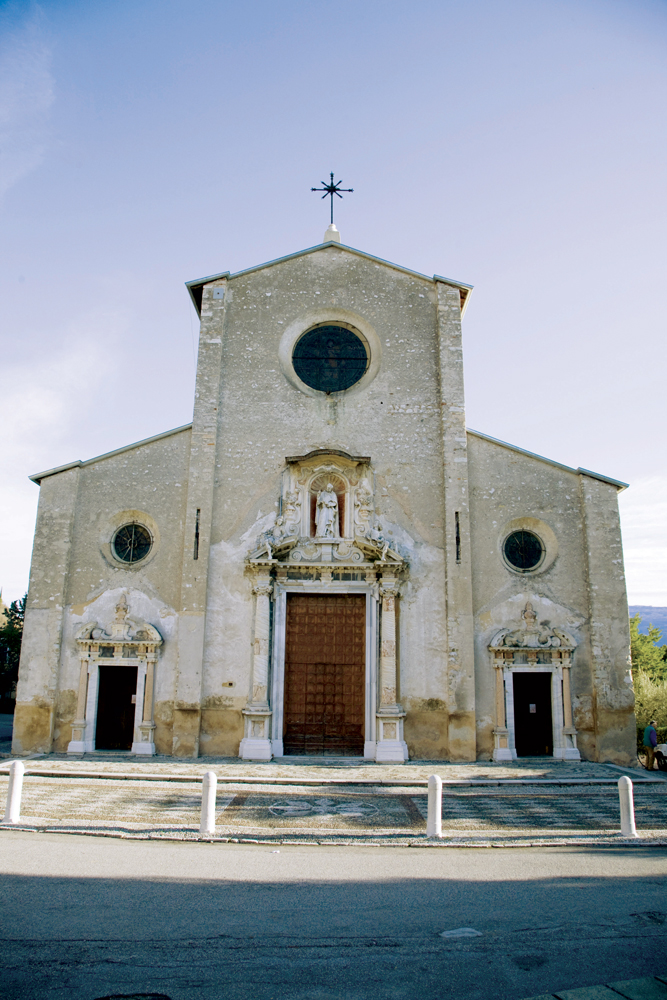
Built in 1584 on the ruins of an old parish church. The austere façade, realized during the XVII Century decorated with two S. Peter statues and two angels, elaborate marble columns, the main two coming from the adjacent Roman Villa. The inside of the church is a proper art gallery with canvases painted by Andrea Celesti between 1688 and the first decade of the 18th Century, depicting S. Peter and Paul’s life. Andrea Celesti relized also the fresco in the apse and in the presbytery, for this reason known as Celest’s Sistine Chapel. There are a lot of tombstones on the floor belonging to the most important families that made the history of Toscolano between the 16th and 17th Century.'
});
t.setStyle(
new ol.style.Style({
image: new ol.style.Circle({
fill: new ol.style.Fill({
color: '#be6acd'
}),
radius: 8,
stroke: new ol.style.Stroke({
color: '#000000',
width: 1,
}),
}),
}),
);
iconList.push(t);
var iconLayer = new ol.layer.Vector({
source: new ol.source.Vector({
features: iconList,
}),
});
vectorList_24.push(iconLayer);
var vectorList_13 = [];
var iconList = [];
style['715'] = {
'Point': new ol.style.Style({
image: new ol.style.Circle({
fill: new ol.style.Fill({
color: 'rgba(255,255,0,0.6)',
}),
radius: 10,
stroke: new ol.style.Stroke({
color: '#ff0',
width: 1,
}),
}),
}),
'LineString': new ol.style.Style({
stroke: new ol.style.Stroke({
color: 'violet',
width: 3,
}),
}),
'MultiLineString': new ol.style.Style({
stroke: new ol.style.Stroke({
color: 'violet',
width: 3,
}),
}),
};
// GPX start
var t = new ol.Feature({
geometry: new ol.geom.Point(ol.proj.fromLonLat([10.637406903483, 45.66953838257])),
name: 'Shrine of Madonna di Supina',
description: '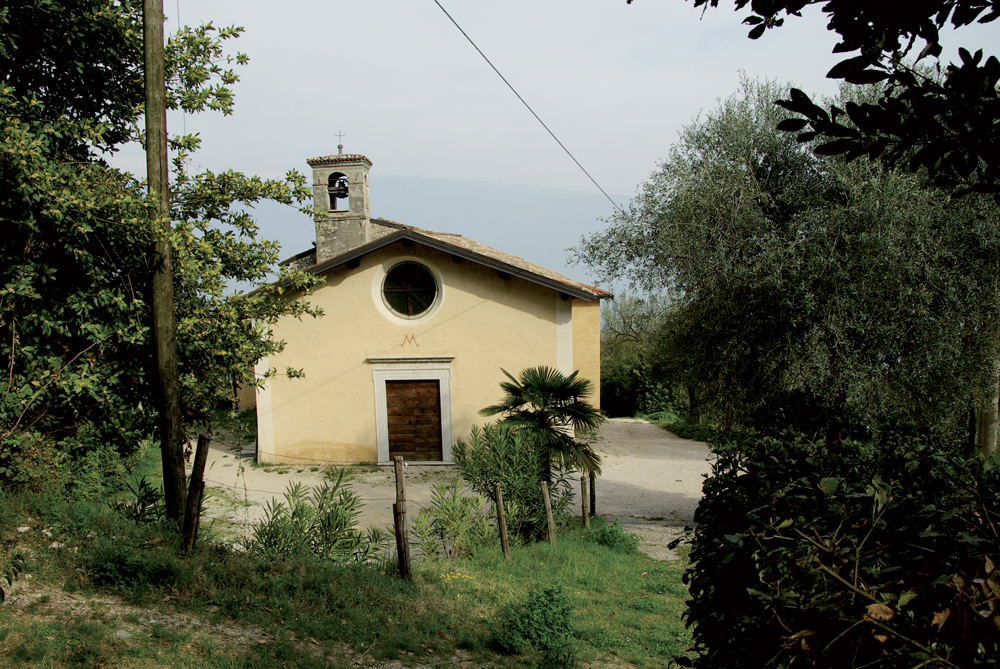
The Madonna di Supina shrine was built at the end of the XV C. by the Toscolano Maderno Municipality. From the second half of the XVI C. the Toscolano community, in order to fulfil a vow, used to have a mass celebrated there every 25th of the month. In 1581 Battista Sgraffignoli left in his will his paper mill in contrada Lupo, in the Papermills Valley, for the celebrations and money to finish the construction of the church and its decoration. As stated in his will, the interior decoration was made between 1583 and 1590 with paintings representing the life of the Virgin and placed between frescoed architectural frames. The statue of the Virgin enthroned in the apse dates back to the half of the XV C, and has a XVII C. wooden altarpiece.
'
});
t.setStyle(
new ol.style.Style({
image: new ol.style.Circle({
fill: new ol.style.Fill({
color: 'violet'
}),
radius: 8,
stroke: new ol.style.Stroke({
color: '#000000',
width: 1,
}),
}),
}),
);
iconList.push(t);
var iconLayer = new ol.layer.Vector({
source: new ol.source.Vector({
features: iconList,
}),
});
vectorList_13.push(iconLayer);
// PUNTI end ************************************************************************************
var view = new ol.View({
center: ol.proj.transform([10.61147, 45.6421428], 'EPSG:4326', 'EPSG:3857'),
//maxZoom: 18,
zoom: 14
})
var map = new ol.Map({
//controls: ol.control.defaults().extend([new ol.control.FullScreen()]),
target: 'map',
overlays: [overlay],
layers: [
// LAYOUT DELLA CARTINA
new ol.layer.Group({
title: 'Show', // A layer must have a title to appear in the layerswitcher
layers: [
new ol.layer.Group({
title: 'Terrain', // A layer must have a title to appear in the layerswitcher
type: 'base', // Setting the layers type to 'base' results in it having a radio button and only one base layer being visibile at a time
combine: true, // Setting combine to true causes sub-layers to be hidden in the layerswitcher, only the parent is shown
visible: false,
layers: [
new ol.layer.Tile({
source: new ol.source.Stamen({
layer: 'terrain'
})
})
]
}),
new ol.layer.Tile({
title: 'Elevation contour lines',
type: 'base',
source: new ol.source.XYZ({
attributions: 'Tiles © ArcGIS',
url: 'https://server.arcgisonline.com/ArcGIS/rest/services/World_Topo_Map/MapServer/tile/{z}/{y}/{x}',
}),
}),
new ol.layer.Tile({
title: 'Satellite',
type: 'base',
source: new ol.source.XYZ({
attributions: 'Tiles © Esri — Source: Esri, i-cubed, USDA, USGS, AEX, GeoEye, Getmapping, Aerogrid, IGN, IGP, UPR-EGP, and the GIS User Community',
url: 'https://server.arcgisonline.com/ArcGIS/rest/services/World_Imagery/MapServer/tile/{z}/{y}/{x}.jpg',
maxZoom: 19,
}),
}),
new ol.layer.Tile({
title: 'Map', // A layer must have a title to appear in the layerswitcher
type: 'base', // Again set this layer as a base layer
visible: true,
source: new ol.source.OSM()
}),
]
}),
new ol.layer.Group({
title: 'Culture',
fold: 'open', // Adding a 'fold' property set to either 'open' or 'close' makes the group layer collapsible
layers: [
new ol.layer.Group({
title: '•
Altro',
layers: vectorList_a
}),
new ol.layer.Group({
title: '•
MONUMENTS',
layers: vectorList_16
}),
new ol.layer.Group({
title: '•
CULTURAL SITE',
layers: vectorList_23
}),
new ol.layer.Group({
title: '•
VILLAS AND PALACES',
layers: vectorList_27
}),
new ol.layer.Group({
title: '•
MUSEUMS AND PARKS',
layers: vectorList_26
}),
new ol.layer.Group({
title: '•
ITALIAN SOCIAL REPUBLIC',
layers: vectorList_25
}),
new ol.layer.Group({
title: '•
ARCHITECTURAL WORK',
layers: vectorList_37
}),
new ol.layer.Group({
title: '•
CHURCHES',
layers: vectorList_24
}),
new ol.layer.Group({
title: '•
CULT',
layers: vectorList_13
}),
]
}),
],
view: view,
});
// GEOLOCALIZZAZIONE start ************************************************************************************
var geolocation = new ol.Geolocation({
// enableHighAccuracy must be set to true to have the heading value.
trackingOptions: {
enableHighAccuracy: true,
},
projection: view.getProjection(),
});
function el(id) {
return document.getElementById(id);
}
el('track').addEventListener('change', function () {
geolocation.setTracking(this.checked);
});
geolocation.on('change', function () {
el('accuracy').innerText = geolocation.getAccuracy() + ' [m]';
el('altitude').innerText = geolocation.getAltitude() + ' [m]';
el('altitudeAccuracy').innerText = geolocation.getAltitudeAccuracy() + ' [m]';
el('heading').innerText = geolocation.getHeading() + ' [rad]';
el('speed').innerText = geolocation.getSpeed() + ' [m/s]';
el('position').innerText = geolocation.getPosition();
});
// handle geolocation error.
geolocation.on('error', function (error) {
var info = document.getElementById('info-track');
info.innerHTML = error.message;
info.style.display = '';
});
var accuracyFeature = new ol.Feature();
geolocation.on('change:accuracyGeometry', function () {
accuracyFeature.setGeometry(geolocation.getAccuracyGeometry());
map.getView().animate({ center: geolocation.getPosition() }, { duration: 750 });
});
var positionFeature = new ol.Feature();
positionFeature.setStyle(
new ol.style.Style({
image: new ol.style.Circle({
radius: 6,
fill: new ol.style.Fill({
color: '#3399CC',
}),
stroke: new ol.style.Stroke({
color: '#fff',
width: 2,
}),
}),
})
);
// geolocation.on('change:position', function () {
geolocation.on('change', function () {
var coordinates = geolocation.getPosition();
positionFeature.setGeometry(coordinates ? new ol.geom.Point(coordinates) : null);
});
new ol.layer.Vector({
map: map,
source: new ol.source.Vector({
features: [accuracyFeature, positionFeature],
}),
});
// GEOLOCALIZZAZIONE end ************************************************************************************
// LINK To POINT start ************************************************************************************
var zoomto_698 = document.getElementById('zoomto_698');
zoomto_698.addEventListener(
'click',
function (evt) {
var geometry = ol.proj.fromLonLat([10.599563996507213, 45.634780380617904]);
map.getView().animate({ center: geometry, zoom: 16 }, { duration: 750 });
var hdms = ol.coordinate.toStringHDMS(ol.proj.toLonLat(geometry));
content.innerHTML = 'Anchor of the \"Flottiglia MAS\"
It’s a 478kg anchor pulled out from the bottom of the lake in 2011. It was used to anchor a big circular buoy where in 1918 3 MAS (torpedo-armed motorboat) were moored, sent by the Navy the last year of WWI in order to defend from enemy attacks, since the area was considered a front line zone. It commemorates the fallen of the Navy
' + hdms + '' ;
overlay.setPosition(geometry);
},
false
);
var zoomto_701 = document.getElementById('zoomto_701');
zoomto_701.addEventListener(
'click',
function (evt) {
var geometry = ol.proj.fromLonLat([10.598521, 45.635838]);
map.getView().animate({ center: geometry, zoom: 16 }, { duration: 750 });
var hdms = ol.coordinate.toStringHDMS(ol.proj.toLonLat(geometry));
content.innerHTML = 'Bella Italia
Inaugurated in 1909 in honour of the stateman and Prime Minister Giuseppe Zanardelli, who lived in Bornico for years. The statue was made by the artist Leonardo Bistolfi. Originally the face of the woman, symbol of the Homeland, looked towards Trieste, that at the time was under the Austria Empire. She was defined as “The desire of a far shore”. On the base is an inscription to Giuseppe zanardelli. The monument was rotated towards north in 1939 when the square was renovated.
' + hdms + '' ;
overlay.setPosition(geometry);
},
false
);
var zoomto_741 = document.getElementById('zoomto_741');
zoomto_741.addEventListener(
'click',
function (evt) {
var geometry = ol.proj.fromLonLat([10.6072463201474, 45.640496226946865]);
map.getView().animate({ center: geometry, zoom: 16 }, { duration: 750 });
var hdms = ol.coordinate.toStringHDMS(ol.proj.toLonLat(geometry));
content.innerHTML = 'Elementary school
The Elementary school building was the seat of the Ministero dell’Interno. Here there were the Police offices and Herbert Kappler’s office, Major of the SS
' + hdms + '' ;
overlay.setPosition(geometry);
},
false
);
var zoomto_708 = document.getElementById('zoomto_708');
zoomto_708.addEventListener(
'click',
function (evt) {
var geometry = ol.proj.fromLonLat([10.605664073434726, 45.63672265292951]);
map.getView().animate({ center: geometry, zoom: 16 }, { duration: 750 });
var hdms = ol.coordinate.toStringHDMS(ol.proj.toLonLat(geometry));
content.innerHTML = 'Monument to the Fallen
Monument dedicated to the fallen of the First World War of Toscolano Maderno, inaugurated in 1937 and realized by Dubbini. This monument has several remains connecte to the most important local activieties: olive oil and paper production On the left side there is a chiselled stone that reminds the Italian soldiers, with the text “beyond the blaze, the enemy rage doesn’t live”. This stone is connected to the traditional paper production, it was part of a set of hammers that beat the rags used to make paper. The fountain on the right corner represents the renewal of life and it was built on a stone used in paper mills as well.
' + hdms + '' ;
overlay.setPosition(geometry);
},
false
);
var zoomto_735 = document.getElementById('zoomto_735');
zoomto_735.addEventListener(
'click',
function (evt) {
var geometry = ol.proj.fromLonLat([10.599601, 45.635236]);
map.getView().animate({ center: geometry, zoom: 16 }, { duration: 750 });
var hdms = ol.coordinate.toStringHDMS(ol.proj.toLonLat(geometry));
content.innerHTML = 'Monumento of St. Ercolano
The marble statue is dedicated to St. Ercolano, the patron saint of Maderno and also of the Riviera, celebrated on August 12. It was built in 1838 by the sculptor Cesare Nesti and Adamo Tagliani. It was the result of a promise made by the people of Maderno, when an epidemic of cholera broke out in July 1836.
They asked to S. Ercolano to protect the population. In September the epidemic was over and the statue was then built
' + hdms + '' ;
overlay.setPosition(geometry);
},
false
);
var zoomto_716 = document.getElementById('zoomto_716');
zoomto_716.addEventListener(
'click',
function (evt) {
var geometry = ol.proj.fromLonLat([10.607736729452402, 45.63983024327686]);
map.getView().animate({ center: geometry, zoom: 16 }, { duration: 750 });
var hdms = ol.coordinate.toStringHDMS(ol.proj.toLonLat(geometry));
content.innerHTML = 'Statues of three Saints
They represent the Virgin, St. Francesco d\'Assisi and San Giovanni Nepomuceno.
The statues belonged to Marshall Giuseppe Ferrari and originally they were on the portal of his palace
' + hdms + '' ;
overlay.setPosition(geometry);
},
false
);
var zoomto_718 = document.getElementById('zoomto_718');
zoomto_718.addEventListener(
'click',
function (evt) {
var geometry = ol.proj.fromLonLat([10.598902, 45.635768]);
map.getView().animate({ center: geometry, zoom: 16 }, { duration: 750 });
var hdms = ol.coordinate.toStringHDMS(ol.proj.toLonLat(geometry));
content.innerHTML = 'The Lion and S. Marco square
The column, symbol of the Serenissima Republic of Venice was built in 1610 in front of the old town hall of Maderno. On the base the are low reliefs representing Saint Andrew, patron saint of Maderno, and Saint Herculanums, patron saint of the entire Riviera. According to the local tradition, when the Republic of Venice fell in 1797, the original stone lion was thrown into the giulf. The current bronze sculpture was made in 1902 by Ettore Ximenes (Palermo, 1855 – Rome, 1926) who donated it to the community of Maderno.
' + hdms + '' ;
overlay.setPosition(geometry);
},
false
);
var zoomto_732 = document.getElementById('zoomto_732');
zoomto_732.addEventListener(
'click',
function (evt) {
var geometry = ol.proj.fromLonLat([10.600225465178168, 45.63463308569395]);
map.getView().animate({ center: geometry, zoom: 16 }, { duration: 750 });
var hdms = ol.coordinate.toStringHDMS(ol.proj.toLonLat(geometry));
content.innerHTML = 'Bell Tower (Ex Castle)
It\'s the only part remaining of the big castle, probably built during the VIII Century. It had a double row of curtain walls, surrounded by a moat, with 4 towers. On the side of the square there was the drawbridge.Inside of the castle, that faced a wide courtyard, there was a Palace that from 1336 was the seat of the administration of the Comunità di Riviera and then residence of the Vicar of the Magnifica Patria. The palace and the castle were severely dameged by a fire in 1645 and demolished (except the tower) in order to build the parish church a century after.
' + hdms + '' ;
overlay.setPosition(geometry);
},
false
);
var zoomto_770 = document.getElementById('zoomto_770');
zoomto_770.addEventListener(
'click',
function (evt) {
var geometry = ol.proj.fromLonLat([10.604022848351109, 45.63963246185194]);
map.getView().animate({ center: geometry, zoom: 16 }, { duration: 750 });
var hdms = ol.coordinate.toStringHDMS(ol.proj.toLonLat(geometry));
content.innerHTML = 'Fontane
' + hdms + '' ;
overlay.setPosition(geometry);
},
false
);
var zoomto_744 = document.getElementById('zoomto_744');
zoomto_744.addEventListener(
'click',
function (evt) {
var geometry = ol.proj.fromLonLat([10.608396690330533, 45.64106543677046]);
map.getView().animate({ center: geometry, zoom: 16 }, { duration: 750 });
var hdms = ol.coordinate.toStringHDMS(ol.proj.toLonLat(geometry));
content.innerHTML = 'Former Town Hall
It belonged to Ettore Bianchi, who had been manager of the Maffizzoli Papermill for several years, it is now seat of the Library and the Ecomuseum. On the base of the balcony the writing NULLA DIES SINE LINE, \"not a day without tracing a line\" a quote attributed to Apelles.
' + hdms + '' ;
overlay.setPosition(geometry);
},
false
);
var zoomto_730 = document.getElementById('zoomto_730');
zoomto_730.addEventListener(
'click',
function (evt) {
var geometry = ol.proj.fromLonLat([10.609055700445758, 45.64140801163121]);
map.getView().animate({ center: geometry, zoom: 16 }, { duration: 750 });
var hdms = ol.coordinate.toStringHDMS(ol.proj.toLonLat(geometry));
content.innerHTML = 'The old Bridge
So called to distinguish it from the new bridge built in 1908, it dates back to the early 16th Century and its construction was ordered in 1497, payed by the Magnifica Patria. They say that up until mid 19th Century on the parapet towards the mount there were two niches, one with a fragment of a sculpture representing a woman with a tiara.
Here there was Contrada Ponte (bridge), the first contrada of Toscolano for those arriving from Maderno and it was crossed by the Strada Regia that continued in via Trento.
Before the contruction of the bridge people crossed the river through fords
' + hdms + '' ;
overlay.setPosition(geometry);
},
false
);
var zoomto_710 = document.getElementById('zoomto_710');
zoomto_710.addEventListener(
'click',
function (evt) {
var geometry = ol.proj.fromLonLat([10.61918884246249, 45.64606058703979]);
map.getView().animate({ center: geometry, zoom: 16 }, { duration: 750 });
var hdms = ol.coordinate.toStringHDMS(ol.proj.toLonLat(geometry));
content.innerHTML = 'The Toscolano Harbor
Charming and quiet, the small harbour is surrounded by ancient buildings once inhabited by noble families, such as the Delai Palace on the left of the square, that dates back to the XVII Century and preserves beautiful frescoes. Between the 15th and the 17th century it was a busy distribution centre of goods and iron, where the boats came from and went to Venice.
From the harbour of Toscolano you can admire what remains of one of the many lemon gardens which dotted the territory of Toscolano until the beginning of the XX century and represented a major source of local income. Citrus fruits grown, especially lemons, were exported across Europe. The cultivation was probably introduced by Franciscan friars in the thirteenth century and abandoned in the early twentieth century because it was no longer competitive.
' + hdms + '' ;
overlay.setPosition(geometry);
},
false
);
var zoomto_703 = document.getElementById('zoomto_703');
zoomto_703.addEventListener(
'click',
function (evt) {
var geometry = ol.proj.fromLonLat([10.616500971707813, 45.6408105071995]);
map.getView().animate({ center: geometry, zoom: 16 }, { duration: 750 });
var hdms = ol.coordinate.toStringHDMS(ol.proj.toLonLat(geometry));
content.innerHTML = 'The Toscolano Papermill
The papermill of Toscolano was built thanks to Andrea Maffizzoli and the Maffizzoli Brothers Company who were already the owners of some papermills in the Valley and they wanted to build a new papermill on the lakeshore, in Capra, equipped with the most modern machinery for paper production. The construction begun in 1906 and the papermill officially opened on March 19th 1910. In 1927 the 5 Maffizzoli’s papermills had 1100 workers. In 1945 the building in Toscolano was bombed and semi destroyed by the Allied.
From 1989 has been part of the Marchi Group and from 2007 of the Burgo Group. The papermill hires now 370 workers
' + hdms + '' ;
overlay.setPosition(geometry);
},
false
);
var zoomto_699 = document.getElementById('zoomto_699');
zoomto_699.addEventListener(
'click',
function (evt) {
var geometry = ol.proj.fromLonLat([10.596475, 45.635198]);
map.getView().animate({ center: geometry, zoom: 16 }, { duration: 750 });
var hdms = ol.coordinate.toStringHDMS(ol.proj.toLonLat(geometry));
content.innerHTML = 'Wash house
It dates back to the 19th Century and it belonged to the Park Hotel, one of the first hotels built in Maderno.
Between the hotel and the wash house there was a garden, expropriated in 1899 for the construction of the road.
' + hdms + '' ;
overlay.setPosition(geometry);
},
false
);
var zoomto_739 = document.getElementById('zoomto_739');
zoomto_739.addEventListener(
'click',
function (evt) {
var geometry = ol.proj.fromLonLat([10.600376275448935, 45.63626531979006]);
map.getView().animate({ center: geometry, zoom: 16 }, { duration: 750 });
var hdms = ol.coordinate.toStringHDMS(ol.proj.toLonLat(geometry));
content.innerHTML = 'Benamati Palace
Palazzo Benamati was designated by his owner, Don Cristoforo Benamati, who died in 1799, as the seat of a school for children from Maderno. It was the seat of the elementary school until 1927 and kindergarten until the 70s. Today it is the location for cultural events, shows and concerts.
Inside, the big hall is dedicated to Andrea Celesti.
Traces of the 18th Century decorations are stil visible today.
The painting in the hall comes from Villa Serraglio and it represents a burning city
' + hdms + '' ;
overlay.setPosition(geometry);
},
false
);
var zoomto_727 = document.getElementById('zoomto_727');
zoomto_727.addEventListener(
'click',
function (evt) {
var geometry = ol.proj.fromLonLat([10.600610283346228, 45.63753490873119]);
map.getView().animate({ center: geometry, zoom: 16 }, { duration: 750 });
var hdms = ol.coordinate.toStringHDMS(ol.proj.toLonLat(geometry));
content.innerHTML = 'Bulgheroni Palace
Palazzo Bulgheroni, also known as Villa Lucia, belongs to an elegant historical complex surrounded by a wide wall surmonted by big stone balls with a small tower in its corner. The big ashlar gate opens on a garden towards which the villa is faced to and a scenographic staircase with satues, vats and mascarons that leads to the terraces of an old lemon garden. The palace has an interesting frescoed frieze beneath the roof with putti and mythological figures. The plan of the building dates back to the XVII C. In 1707 the property beloged to the counts Rizzardi, whose emblems are on the shield of one of the statues on the staircase. From the end of the XIX C, it belonged to the Bulgheroni Family.
' + hdms + '' ;
overlay.setPosition(geometry);
},
false
);
var zoomto_740 = document.getElementById('zoomto_740');
zoomto_740.addEventListener(
'click',
function (evt) {
var geometry = ol.proj.fromLonLat([10.618579915812077, 45.64616360829389]);
map.getView().animate({ center: geometry, zoom: 16 }, { duration: 750 });
var hdms = ol.coordinate.toStringHDMS(ol.proj.toLonLat(geometry));
content.innerHTML = 'Delai Palace
The palace dates back to the 17th Century, flanked by several lemon groves, still visible today, a garden on the lakeshore and has fine frescoes on the external plasters. Here, Scipione Delai hosted Andrea Celesti, who realized numerous canvases fo this palace, today in Brescia.
The property passed to the Maffizzoli and the Oldi
' + hdms + '' ;
overlay.setPosition(geometry);
},
false
);
var zoomto_709 = document.getElementById('zoomto_709');
zoomto_709.addEventListener(
'click',
function (evt) {
var geometry = ol.proj.fromLonLat([10.600314439165508, 45.63644853732234]);
map.getView().animate({ center: geometry, zoom: 16 }, { duration: 750 });
var hdms = ol.coordinate.toStringHDMS(ol.proj.toLonLat(geometry));
content.innerHTML = 'Gonzaga Palace
In the 19th Century the palace was partly damaged, and what we can see today it is only one third of the original building. On the ground floor (known as “piano nobile” in Italian) the doors and the walls are preciously decorated with 17th Century motifs. Interesting facts: Most of the decoration left recreates an illusory appearance of a Baroque architecture by the use of peculiar colors and art technique resembling movements. All over the place you can see between the columns, balustrades and recesses in the walls different paintings such as flower vases and garlands, idyllic landscapes, portraits and mythological scenes.
Besides the amazing decoration of the interiors, there was an outstanding park outside, stretching over 70 hectares, between the palace and the lakeshore. To walk down, there was a pathway passing through different kind of trees, such as laurels, olive trees and mulberries and leading near the area now known as “ex campo ippico” (which means “former hippodrome”). From a drawing, year 1623, we know that it was surrounded by geometrically-shaped boxwood beds. On the side of the garden there were rows of lemon greenhouses (the definition found in an old document says “ walled cedar greenhouses”), special greenhouses to growing citrus fruits. Interesting facts: From an old inventory we found out that in the greenhouses of the Gonzaga’s during the lemon harvesting season in 1635, they gathered 22.600 lemons, each measuring 18 cm (about 7 inches) in circumference and there were 60.000 lemons already ripen but still hanging on the trees.
' + hdms + '' ;
overlay.setPosition(geometry);
},
false
);
var zoomto_771 = document.getElementById('zoomto_771');
zoomto_771.addEventListener(
'click',
function (evt) {
var geometry = ol.proj.fromLonLat([10.605244, 45.652062]);
map.getView().animate({ center: geometry, zoom: 16 }, { duration: 750 });
var hdms = ol.coordinate.toStringHDMS(ol.proj.toLonLat(geometry));
content.innerHTML = 'Maffizzoli Palace
Property of the Maffizzoli family, famous paper makers. It was built on the side of the river at the entrance of Maina Superiore, that was the main paper production centre at the end of the 19th Century
' + hdms + '' ;
overlay.setPosition(geometry);
},
false
);
var zoomto_726 = document.getElementById('zoomto_726');
zoomto_726.addEventListener(
'click',
function (evt) {
var geometry = ol.proj.fromLonLat([10.597196, 45.636709]);
map.getView().animate({ center: geometry, zoom: 16 }, { duration: 750 });
var hdms = ol.coordinate.toStringHDMS(ol.proj.toLonLat(geometry));
content.innerHTML = 'Serraglio Gonzaga
The Serraglio Palace (from the latin word serraculum, place closed by high walls), over the Maderno hamlet, belonged to the dukes of Mantua, the Gonzaga family, since 1607, that in the same year started the construction of a sumptuous palace in the centre of the town. The Serraglio was rebuilt in 1657 by Carlo II Gonzaga, who connected it to his Palace through an underground way. It was immersed in a big park with water fountains and decorated with sculptures and a rich vegetation. In 1921 the property of the villa was offered to Gabriele d’Annunzio who, however, preferred Villa Cargnacco in Gardone Riviera.
' + hdms + '' ;
overlay.setPosition(geometry);
},
false
);
var zoomto_733 = document.getElementById('zoomto_733');
zoomto_733.addEventListener(
'click',
function (evt) {
var geometry = ol.proj.fromLonLat([10.587393054307, 45.626550260983]);
map.getView().animate({ center: geometry, zoom: 16 }, { duration: 750 });
var hdms = ol.coordinate.toStringHDMS(ol.proj.toLonLat(geometry));
content.innerHTML = 'Villa Zanardelli
On the border with Fasano, Villa Zanardelli was built between 1888 and 1892, based on a project of Tagliaferri, for Giuseppe Zanardelli, an important statist, many-times minister of the Regno d’Italian and Prime Minister.
The interior was designed by Ximenes. Zanardelli died here in 1903. It is now a nursing home for disabled owned by a non-profit foundation.
It can be visited on the occasion of public festivals organized by the Foundation
' + hdms + '' ;
overlay.setPosition(geometry);
},
false
);
var zoomto_745 = document.getElementById('zoomto_745');
zoomto_745.addEventListener(
'click',
function (evt) {
var geometry = ol.proj.fromLonLat([10.61207685763939, 45.63767413608697]);
map.getView().animate({ center: geometry, zoom: 16 }, { duration: 750 });
var hdms = ol.coordinate.toStringHDMS(ol.proj.toLonLat(geometry));
content.innerHTML = 'Visintini Palace
Sumptuous palace in Via Religione that included the monastery complex, already present during the second half of the 13th Century.
The big tower bell and the original planimetry of the church are still visible today
' + hdms + '' ;
overlay.setPosition(geometry);
},
false
);
var zoomto_729 = document.getElementById('zoomto_729');
zoomto_729.addEventListener(
'click',
function (evt) {
var geometry = ol.proj.fromLonLat([10.612287685199416, 45.64235109740499]);
map.getView().animate({ center: geometry, zoom: 16 }, { duration: 750 });
var hdms = ol.coordinate.toStringHDMS(ol.proj.toLonLat(geometry));
content.innerHTML = 'Bernini Park
Situated in the historical centre of Toscolano, there is the biggest tree of the lake; a majestic himalayan cedar tree with a trank of more than 2 m diameter, together with two munumental cedars of Lebanon
' + hdms + '' ;
overlay.setPosition(geometry);
},
false
);
var zoomto_777 = document.getElementById('zoomto_777');
zoomto_777.addEventListener(
'click',
function (evt) {
var geometry = ol.proj.fromLonLat([10.563222671306473, 45.67578248657453]);
map.getView().animate({ center: geometry, zoom: 16 }, { duration: 750 });
var hdms = ol.coordinate.toStringHDMS(ol.proj.toLonLat(geometry));
content.innerHTML = 'Exhibition point Passo Spino
' + hdms + '' ;
overlay.setPosition(geometry);
},
false
);
var zoomto_721 = document.getElementById('zoomto_721');
zoomto_721.addEventListener(
'click',
function (evt) {
var geometry = ol.proj.fromLonLat([10.611458300543886, 45.63881621247144]);
map.getView().animate({ center: geometry, zoom: 16 }, { duration: 750 });
var hdms = ol.coordinate.toStringHDMS(ol.proj.toLonLat(geometry));
content.innerHTML = 'The Botanic Garden \"Ghirardi\"
The garden was open in 1964 as Agricultural Experiment Station of the pharmaceutical company SIMES, wanted by its owner Giordano Emilio Ghirardi, in order to study medicinal plants from all over the world. In 1991 the garden was donated to the Università degli Studi di Milano and it is now run by the Biology Department. The plants of different origin here cultivated are chosen based on their medical interest and indigenous plants for the realisation of project in cooperation with the Comunità Montana Parco Alto Garda Bresciano in order to study the flora of the territory. The Garden is also the location of didactic avtivities, it’s partner of international cooperation such as with the Botanical garden in Valencia, for research, exchange and students visits. Sesasonal openings organised by the University
Info: orto.ghirardi@unimi.it
Info www.unimi.it
' + hdms + '' ;
overlay.setPosition(geometry);
},
false
);
var zoomto_707 = document.getElementById('zoomto_707');
zoomto_707.addEventListener(
'click',
function (evt) {
var geometry = ol.proj.fromLonLat([10.604170415888738, 45.64972537665636]);
map.getView().animate({ center: geometry, zoom: 16 }, { duration: 750 });
var hdms = ol.coordinate.toStringHDMS(ol.proj.toLonLat(geometry));
content.innerHTML = 'The Paper Museum
The paper production centre in Maina Inferiore is a fascinating productive complex transformed in museum. The museum recalls the different phases of paper production from the Middle age to the 20th Century, through an evocative path from the 16th Century nucleus of the mill, where visitors find reproductions of machinery and instruments typical of paper production from 15th to 18th Century to the upper rooms dedicated to the evolution of paper production during the early phases of the Industrial Revolution. In exhibition there are also some findings from the archaeological excavations carried out in the Paper Mill Valley, some watermarks produced between the 16th and 18th Century, and a collection of books printed by the Paganinis, illustrious publishers who owned a print shop in Toscolano and Venice during the first half of the 16th Century. Besides guided tours and didactic workshops about the history of paper, The Centre organises cultural events and exhibitions.
Info
www.valledellecartiere.it ' + hdms + '' ;
overlay.setPosition(geometry);
},
false
);
var zoomto_717 = document.getElementById('zoomto_717');
zoomto_717.addEventListener(
'click',
function (evt) {
var geometry = ol.proj.fromLonLat([10.61828302752718, 45.643419392202766]);
map.getView().animate({ center: geometry, zoom: 16 }, { duration: 750 });
var hdms = ol.coordinate.toStringHDMS(ol.proj.toLonLat(geometry));
content.innerHTML = 'The Roman Villa
One of the most important residential building of the Lake Garda shore built during the roman period. The main part of the complex faced the lake. Due to the plan, the size, the architectural and decorative features, it is part of the lake villas that once existed on the Benacus shore, like the villa in Sirmione and Desenzano del Garda.
The villa probably belonged to the Nonii, one of the mos important brescian families that had a lot of economic business and properties in the lake and country area. Thanks to an inscription the Villa is attributed toMarcus Nonius Macrinus, consul in 154, proconsul of Asia in 170-171, legatus and comes for the Emperor Marcus Aurelius. The sector that is currently visible it’s th southern one, called sector A, that was one of the side wing of the building. Here are several rooms, some of them with mosaic floors and up to 1 m high painted walls.
Opening times: May - September on saturday and sunday (10-12, 3pm-6pm). Free entry
Info 0365-546023' + hdms + '' ;
overlay.setPosition(geometry);
},
false
);
var zoomto_704 = document.getElementById('zoomto_704');
zoomto_704.addEventListener(
'click',
function (evt) {
var geometry = ol.proj.fromLonLat([10.610403592871567, 45.63624550167299]);
map.getView().animate({ center: geometry, zoom: 16 }, { duration: 750 });
var hdms = ol.coordinate.toStringHDMS(ol.proj.toLonLat(geometry));
content.innerHTML = 'Bonaspetti villa
Seat of the Independent Republican Police Department composed of local auxiliary officers
' + hdms + '' ;
overlay.setPosition(geometry);
},
false
);
var zoomto_769 = document.getElementById('zoomto_769');
zoomto_769.addEventListener(
'click',
function (evt) {
var geometry = ol.proj.fromLonLat([10.586185, 45.626012]);
map.getView().animate({ center: geometry, zoom: 16 }, { duration: 750 });
var hdms = ol.coordinate.toStringHDMS(ol.proj.toLonLat(geometry));
content.innerHTML = 'Ex Villa Bassetti
It was the seat of the German Embassy, bombed by the Allied on 4th december 1944. It is now a condominium, on the border with Gardone Riviera
' + hdms + '' ;
overlay.setPosition(geometry);
},
false
);
var zoomto_728 = document.getElementById('zoomto_728');
zoomto_728.addEventListener(
'click',
function (evt) {
var geometry = ol.proj.fromLonLat([10.60751875636301, 45.631131027445676]);
map.getView().animate({ center: geometry, zoom: 16 }, { duration: 750 });
var hdms = ol.coordinate.toStringHDMS(ol.proj.toLonLat(geometry));
content.innerHTML = 'Ex Villa Cavallero
On the lakeshore of Maderno, it was used by Alessandro Pavolini, Secretary of the new Republican Fascist Party
' + hdms + '' ;
overlay.setPosition(geometry);
},
false
);
var zoomto_743 = document.getElementById('zoomto_743');
zoomto_743.addEventListener(
'click',
function (evt) {
var geometry = ol.proj.fromLonLat([10.605147687404417, 45.631533160092985]);
map.getView().animate({ center: geometry, zoom: 16 }, { duration: 750 });
var hdms = ol.coordinate.toStringHDMS(ol.proj.toLonLat(geometry));
content.innerHTML = 'Hotel Bristol
This big building was built at the end of the 1800 and named Villa Margherita. In 1909 became the Strand Hotel Bristol, where kids affected by tubercolosis used to stay during the holidays
Frim 1943 to 1945 was used by Mussolini\'s collaborators
' + hdms + '' ;
overlay.setPosition(geometry);
},
false
);
var zoomto_720 = document.getElementById('zoomto_720');
zoomto_720.addEventListener(
'click',
function (evt) {
var geometry = ol.proj.fromLonLat([10.598209055538318, 45.635834449091774]);
map.getView().animate({ center: geometry, zoom: 16 }, { duration: 750 });
var hdms = ol.coordinate.toStringHDMS(ol.proj.toLonLat(geometry));
content.innerHTML = 'Hotel Golfo - Ex Villa Bianchi
Villa Bianchi, now Hotel Golfo, was built in XVIII C. and modernised in 1894 when the tower and the decorations in liberty style were added. It has been the residence of the mayor of Maderno, Cav. Giovan battista Bianchi, until 1940s. Between 1943 and 1945 it was occupied and was the seat of the Republican Fascist Party and the headquarters of the Black Brigades. It was then property of the Piva Family, that opened the Hotel Palace, then Hotel Golfo. Inside, in 1942 Angelo Landi from Salò made beautiful paintings representing the legend of Engardina, the nymph who gave the blu of her hair to the lake Benaco.
' + hdms + '' ;
overlay.setPosition(geometry);
},
false
);
var zoomto_702 = document.getElementById('zoomto_702');
zoomto_702.addEventListener(
'click',
function (evt) {
var geometry = ol.proj.fromLonLat([10.61239851564997, 45.63783494256213]);
map.getView().animate({ center: geometry, zoom: 16 }, { duration: 750 });
var hdms = ol.coordinate.toStringHDMS(ol.proj.toLonLat(geometry));
content.innerHTML = 'Toscolano Camping
The military company of the Italian Social republic was set against the boundary wall, where now there are the tennis courts
' + hdms + '' ;
overlay.setPosition(geometry);
},
false
);
var zoomto_734 = document.getElementById('zoomto_734');
zoomto_734.addEventListener(
'click',
function (evt) {
var geometry = ol.proj.fromLonLat([10.600364283408126, 45.638163897913664]);
map.getView().animate({ center: geometry, zoom: 16 }, { duration: 750 });
var hdms = ol.coordinate.toStringHDMS(ol.proj.toLonLat(geometry));
content.innerHTML = 'Villa Caprera
It was the seat of the Republican National Guard and prison for many antifascist
' + hdms + '' ;
overlay.setPosition(geometry);
},
false
);
var zoomto_742 = document.getElementById('zoomto_742');
zoomto_742.addEventListener(
'click',
function (evt) {
var geometry = ol.proj.fromLonLat([10.594556697785693, 45.63452885780726]);
map.getView().animate({ center: geometry, zoom: 16 }, { duration: 750 });
var hdms = ol.coordinate.toStringHDMS(ol.proj.toLonLat(geometry));
content.innerHTML = 'Villa Gemma
Maderno (Via Roma). It belonged to the Triboldi family and here the INTERNO Minister Buffarini and the Ministero f National Education Biggini were hosted.
' + hdms + '' ;
overlay.setPosition(geometry);
},
false
);
var zoomto_738 = document.getElementById('zoomto_738');
zoomto_738.addEventListener(
'click',
function (evt) {
var geometry = ol.proj.fromLonLat([10.597948162553598, 45.6361958034773]);
map.getView().animate({ center: geometry, zoom: 16 }, { duration: 750 });
var hdms = ol.coordinate.toStringHDMS(ol.proj.toLonLat(geometry));
content.innerHTML = 'Villa Serenella
The Consul of the militia G. Battista Riggio, one of the members of the special Jury in Verona that sentenced Galeazzo Ciano and others to death, lived in this villa
' + hdms + '' ;
overlay.setPosition(geometry);
},
false
);
var zoomto_772 = document.getElementById('zoomto_772');
zoomto_772.addEventListener(
'click',
function (evt) {
var geometry = ol.proj.fromLonLat([10.616623024484424, 45.6330071038421]);
map.getView().animate({ center: geometry, zoom: 16 }, { duration: 750 });
var hdms = ol.coordinate.toStringHDMS(ol.proj.toLonLat(geometry));
content.innerHTML = 'Pedestrian drawbridge
' + hdms + '' ;
overlay.setPosition(geometry);
},
false
);
var zoomto_500 = document.getElementById('zoomto_500');
zoomto_500.addEventListener(
'click',
function (evt) {
var geometry = ol.proj.fromLonLat([10.599705474709, 45.635790357945]);
map.getView().animate({ center: geometry, zoom: 16 }, { duration: 750 });
var hdms = ol.coordinate.toStringHDMS(ol.proj.toLonLat(geometry));
content.innerHTML = 'S. Andrea Cathedral
It’s one of the best examples of Lombard-Romanesque architecture influenced by Verona: the façade is masterfully made of stones and polychrome marbles that give light and movement. The inside is divided into 3 aisles by quatrefoil based pillar with capitels representing a wide variety of iconographic decorative motives, typical of the Romanesque style.
Visitors can admire a precious painted board by Paolo Veneziano depicting the Virgin with the Child. The rib vaults of the dom aisles of the chancel date back to the end of the 1400s.
In 1580 Cardinal Borromeo gave the order to close the crypt, that was brought back to light in 1962. Here S. Hercolanus\'s relics were preserved, then moved to the new church in 1825.
' + hdms + '' ;
overlay.setPosition(geometry);
},
false
);
var zoomto_737 = document.getElementById('zoomto_737');
zoomto_737.addEventListener(
'click',
function (evt) {
var geometry = ol.proj.fromLonLat([10.599765543738673, 45.63516642642379]);
map.getView().animate({ center: geometry, zoom: 16 }, { duration: 750 });
var hdms = ol.coordinate.toStringHDMS(ol.proj.toLonLat(geometry));
content.innerHTML = 'S. Andrea\'s Church
Saint Andrew’s parish church was built during the second half of the XVIII C. where there was once the castle. Its construction was decided in 1742 and it took lots of decades, the church was consacrated in 1825. In this occasion Saint Herculanus’s relics were solemnly moved from the old romanic church to the new parish. The church is a wide building with one aisle. The side chapels, divided by majestic lesenes, have paintings coming from the old parish. On the right side of the aisle there is the altar dedicated to Saint Ercolano that preserves a urne and his relics. The altar is embellished by a painting representing the saint, made by the school of Paolo Caliatri, known as Il Veronese. On the side of the chapel there are two paintings of the beginning of the XVII C. with the Finding of Saint Hercolanus’s body and the Procession of Saint Herculanus’s relics, where it’s possible to recognise the old square with the castle. The altarpiece in the apse represents the Dead Christ with Saint Andrew, made by Francesco Bassano the Young in the second half of the XVI C.
' + hdms + '' ;
overlay.setPosition(geometry);
},
false
);
var zoomto_722 = document.getElementById('zoomto_722');
zoomto_722.addEventListener(
'click',
function (evt) {
var geometry = ol.proj.fromLonLat([10.600096564629, 45.64535393265]);
map.getView().animate({ center: geometry, zoom: 16 }, { duration: 750 });
var hdms = ol.coordinate.toStringHDMS(ol.proj.toLonLat(geometry));
content.innerHTML = 'S. Martino\'s Church
Close to the district of Sanico, in Prati di San Martino, the small San Martino di Tours’s church was built on an isolated hill near the ravine of the Toscolano river. It was used as lazaretto since the beginning of the 17th Century. The adjacent cemetery hosted the deceased of Maderno and its districts until the end of the 19th Century. It’s a circular church with a rectangular apse. Next to the church there is a small residential building dating back to the 17th Century (see the engraving on the wall) when a hermit used to live here. The original nucleus is the circular building that is now the aisle, and that was supposed to have a small apse east and a pronaos west.
' + hdms + '' ;
overlay.setPosition(geometry);
},
false
);
var zoomto_711 = document.getElementById('zoomto_711');
zoomto_711.addEventListener(
'click',
function (evt) {
var geometry = ol.proj.fromLonLat([10.616715872936, 45.65003075128]);
map.getView().animate({ center: geometry, zoom: 16 }, { duration: 750 });
var hdms = ol.coordinate.toStringHDMS(ol.proj.toLonLat(geometry));
content.innerHTML = 'S. Michele\'s Church
The old parish church dates back to the 15th Century and it’s right in front of the new parish. Probably built on the ruins of an old fortalice, documented as castellum (castle) in the Middle Ages. San Michele was the main saint for the Longobards. The tower bell looks like a defence tower, at its base there is a “recycled” roman inscription recalling Antoninus Pius and Marcus Aurelius. The portico dates back to the 16th C The church had 3 altars dedicated to San Michele, San Rocco and the Trinity, it was surrounded by a cemetery, a rectory and a rural house. It is now seat of meetings and offices.
' + hdms + '' ;
overlay.setPosition(geometry);
},
false
);
var zoomto_712 = document.getElementById('zoomto_712');
zoomto_712.addEventListener(
'click',
function (evt) {
var geometry = ol.proj.fromLonLat([10.630855041267, 45.656695606253]);
map.getView().animate({ center: geometry, zoom: 16 }, { duration: 750 });
var hdms = ol.coordinate.toStringHDMS(ol.proj.toLonLat(geometry));
content.innerHTML = 'S. Nicola\'s Church
On the top of a hill in Cecina, it\'s a parish church of medieval origin, restored by Pasino Gozio dei Boselli during the 16th Century. The church was enlarged in 1744 adding 2 side chapels in front of which there are the tombs of the noble Zuanelli family decorated with their emblem.
The one dedicated to the Virgin and the Child is most sumptuous, and it has a fresco of the XV C. with a baroque stucco frame. On the other side, the altar dedicated to Sant’Alipyus with San Dominic and Filippo Neri was made in 1701, and it preserves a painting of Andrea Celesti (1637-1712 ca). Of the same author the altarpiece closer to the presbitery showing the Stoning of Saint Stephen and Virgin in Glory with Saints, John the Baptist, Lucy and Rock .
There is also a portrait representing a young member of the Boselli family praying an image of San Nicola, attributed to Girolamo Pilotti in the 1500s
' + hdms + '' ;
overlay.setPosition(geometry);
},
false
);
var zoomto_713 = document.getElementById('zoomto_713');
zoomto_713.addEventListener(
'click',
function (evt) {
var geometry = ol.proj.fromLonLat([10.614396139027365, 45.65462032356168]);
map.getView().animate({ center: geometry, zoom: 16 }, { duration: 750 });
var hdms = ol.coordinate.toStringHDMS(ol.proj.toLonLat(geometry));
content.innerHTML = 'S. Sebastiano\'s Church
It’s a small church in the middle of Gaino. There aren’t info about the period of its construction.
San Sebastiano, who protects from contagious diseases, is represented with San Rocco and the Virgin
' + hdms + '' ;
overlay.setPosition(geometry);
},
false
);
var zoomto_723 = document.getElementById('zoomto_723');
zoomto_723.addEventListener(
'click',
function (evt) {
var geometry = ol.proj.fromLonLat([10.570067005522034, 45.657004753412664]);
map.getView().animate({ center: geometry, zoom: 16 }, { duration: 750 });
var hdms = ol.coordinate.toStringHDMS(ol.proj.toLonLat(geometry));
content.innerHTML = 'S. Urbano\'s Church
The current sacred building was rebuilt in 1928 thanks to Cav. Bianchi, mayor of Maderno, near an older church already existing in the XIV C. that, according to the tradition, was built as sign of devotion for the “lucky escape” from the plague.
' + hdms + '' ;
overlay.setPosition(geometry);
},
false
);
var zoomto_724 = document.getElementById('zoomto_724');
zoomto_724.addEventListener(
'click',
function (evt) {
var geometry = ol.proj.fromLonLat([10.612592, 45.633150]);
map.getView().animate({ center: geometry, zoom: 16 }, { duration: 750 });
var hdms = ol.coordinate.toStringHDMS(ol.proj.toLonLat(geometry));
content.innerHTML = 'Santa Maria Immacolata al Promontorio\'s Church
Small oratory, property of the Bonaspetti family. it was built in 1863 by the Franceschini. brothers to commemorate their parents Antonio and Santina
Above the altar, the Virgin with st. Antonio and St. Santina painted by Francesco Podesti
' + hdms + '' ;
overlay.setPosition(geometry);
},
false
);
var zoomto_714 = document.getElementById('zoomto_714');
zoomto_714.addEventListener(
'click',
function (evt) {
var geometry = ol.proj.fromLonLat([10.618391662415, 45.64467700808]);
map.getView().animate({ center: geometry, zoom: 16 }, { duration: 750 });
var hdms = ol.coordinate.toStringHDMS(ol.proj.toLonLat(geometry));
content.innerHTML = 'Santuario di Santa Maria del Benaco
The small Church situated at the back of the parish is dedicated to Santa Maria del Benaco and it boasts very ancient origins. The existing plant, which is rectangular with a single nave, dates back to the XV century. If the external appearance is poor and without decorations, the inside is full of beautiful frescoes dating back to the second half of the 15th century and completed in 1514, representing emblems of the important families that contributed to the restoration of the church and were buried here.
The four columns in the middle of the parvis were part of a medieval or romanic ciborium demolished in 1580 by order of Carlo Borromeo, because the main altar had a pagan capitel representing Jupiter Ammon
During the restoration works in 1829 a mosaic floo came to light, probably it belonged to the Roman Villa
' + hdms + '' ;
overlay.setPosition(geometry);
},
false
);
var zoomto_731 = document.getElementById('zoomto_731');
zoomto_731.addEventListener(
'click',
function (evt) {
var geometry = ol.proj.fromLonLat([10.591159272696974, 45.63441476270746]);
map.getView().animate({ center: geometry, zoom: 16 }, { duration: 750 });
var hdms = ol.coordinate.toStringHDMS(ol.proj.toLonLat(geometry));
content.innerHTML = 'St Faustino and St Giovita\'s Church
The eighteenth C. Church in Maclino has a unique aisle. The facade is horizontally divided by a gypsum belt course, vertically by twin lesenes supporting the gable. Inside, two side chapels with wooden altars dedicated to the Sacred Heart and to Our Lady of the Rosary. The last one preserves an altarpiece made by Andrea Bertanza from Salò in 1626, it represents the Virgin with Saints Macario and Felicita. On the left of the presbitery there is the canvas of the same author representing the Virgin and the Child with San Carlo Borromeo, Saint Andrew, Saint Herculanus and a benefactor.
' + hdms + '' ;
overlay.setPosition(geometry);
},
false
);
var zoomto_725 = document.getElementById('zoomto_725');
zoomto_725.addEventListener(
'click',
function (evt) {
var geometry = ol.proj.fromLonLat([10.609422185742, 45.657457385446]);
map.getView().animate({ center: geometry, zoom: 16 }, { duration: 750 });
var hdms = ol.coordinate.toStringHDMS(ol.proj.toLonLat(geometry));
content.innerHTML = 'St. Filippo and St. Giacomo\'s Church
Small chapel realised during the 16th Century by the Tamagnini family. Dedicated to Filippo and Giacomo, protectors of paper makers.
Small and plain structure with beautiful stucco decorations made by Davide Rieti, famous sculptor who worked for the Dome in Salò and fort the Inviolata\'s Curch in Riva del Garda.
Abandoned over a long time, the church has been taken to its original beauty thanks to recent restoration works.
WARNING This part of the valley is temporarily closed
' + hdms + '' ;
overlay.setPosition(geometry);
},
false
);
var zoomto_706 = document.getElementById('zoomto_706');
zoomto_706.addEventListener(
'click',
function (evt) {
var geometry = ol.proj.fromLonLat([10.645940182339, 45.66563927187]);
map.getView().animate({ center: geometry, zoom: 16 }, { duration: 750 });
var hdms = ol.coordinate.toStringHDMS(ol.proj.toLonLat(geometry));
content.innerHTML = 'St. George\'s Church
Saint George’s church was founded during the Middle Age, along the ancient royal road, on the top of a hill where the castle of the Pellicani must have been. The façade has a roman corinthian capital. In the apse of the XV C. there is the altarpiece with Saint George slaying the dragon painted by Nicola Grisiani, from Salò, around 1646/47 and a fine altar with polychrome marbles. Under the mensa (tabletop) of the altar there is a roman epigraph dedicated to Lorenia Mercatilla. There are two side altars, one preserves the fine altarpiece with Andrea Celesti’s Piety. The facade of the church was redone during the XVIII C. and completed in 1752 (see the date on the façade). The whole aisle has been repainted during the XX C.
' + hdms + '' ;
overlay.setPosition(geometry);
},
false
);
var zoomto_736 = document.getElementById('zoomto_736');
zoomto_736.addEventListener(
'click',
function (evt) {
var geometry = ol.proj.fromLonLat([10.560028591989914, 45.69792022216966]);
map.getView().animate({ center: geometry, zoom: 16 }, { duration: 750 });
var hdms = ol.coordinate.toStringHDMS(ol.proj.toLonLat(geometry));
content.innerHTML = 'St. Mary of the Snows
In Campiglio di Cima (mt. 1025) there is a small church entitled to St. Maria della Neve (St. Mary of the Snows) that dates back to 1602. It was built together with the cottage and some other buildings by the Andreoli family, stockmen from Valvestino.
During the XVII Century the church was embellished thanks to Stefania Zambelli from Gaino, who was used to go there everyday, no matter what the weather was like.
The complex is now run by the Alpini
' + hdms + '' ;
overlay.setPosition(geometry);
},
false
);
var zoomto_705 = document.getElementById('zoomto_705');
zoomto_705.addEventListener(
'click',
function (evt) {
var geometry = ol.proj.fromLonLat([10.617672904071, 45.644477614539]);
map.getView().animate({ center: geometry, zoom: 16 }, { duration: 750 });
var hdms = ol.coordinate.toStringHDMS(ol.proj.toLonLat(geometry));
content.innerHTML = 'St. Peter and St. Paul\'s Church
Built in 1584 on the ruins of an old parish church. The austere façade, realized during the XVII Century decorated with two S. Peter statues and two angels, elaborate marble columns, the main two coming from the adjacent Roman Villa. The inside of the church is a proper art gallery with canvases painted by Andrea Celesti between 1688 and the first decade of the 18th Century, depicting S. Peter and Paul’s life. Andrea Celesti relized also the fresco in the apse and in the presbytery, for this reason known as Celest’s Sistine Chapel. There are a lot of tombstones on the floor belonging to the most important families that made the history of Toscolano between the 16th and 17th Century.
' + hdms + '' ;
overlay.setPosition(geometry);
},
false
);
var zoomto_715 = document.getElementById('zoomto_715');
zoomto_715.addEventListener(
'click',
function (evt) {
var geometry = ol.proj.fromLonLat([10.637406903483, 45.66953838257]);
map.getView().animate({ center: geometry, zoom: 16 }, { duration: 750 });
var hdms = ol.coordinate.toStringHDMS(ol.proj.toLonLat(geometry));
content.innerHTML = 'Shrine of Madonna di Supina
The Madonna di Supina shrine was built at the end of the XV C. by the Toscolano Maderno Municipality. From the second half of the XVI C. the Toscolano community, in order to fulfil a vow, used to have a mass celebrated there every 25th of the month. In 1581 Battista Sgraffignoli left in his will his paper mill in contrada Lupo, in the Papermills Valley, for the celebrations and money to finish the construction of the church and its decoration. As stated in his will, the interior decoration was made between 1583 and 1590 with paintings representing the life of the Virgin and placed between frescoed architectural frames. The statue of the Virgin enthroned in the apse dates back to the half of the XV C, and has a XVII C. wooden altarpiece.
' + hdms + '' ;
overlay.setPosition(geometry);
},
false
);
// LINK To POINT end ************************************************************************************
// POPOUP start ************************************************************************************
var element = document.getElementById('popup');
var popup = new ol.Overlay({
element: element,
positioning: 'bottom-center',
stopEvent: false,
offset: [0, 0],
});
map.addOverlay(popup);
map.on('singleclick', function (evt) {
$(element).popover('dispose');
var feature = map.forEachFeatureAtPixel(evt.pixel, function (feature) {
return feature;
});
if (feature) {
var coordinate = evt.coordinate;
var hdms = ol.coordinate.toStringHDMS(ol.proj.toLonLat(coordinate));
content.innerHTML = '' + feature.get('name') + '
' + feature.get('description') + '
' + hdms + '';
overlay.setPosition(coordinate);
}
});
// POPOUP end ************************************************************************************
// Get out-of-the-map div element with the ID "layers" and renders layers to it.
// NOTE: If the layers are changed outside of the layer switcher then you
// will need to call ol.control.LayerSwitcher.renderPanel again to refesh
// the layer tree. Style the tree via CSS.
var sidebar = new ol.control.Sidebar({
element: 'sidebar',
position: 'left'
});
var toc = document.getElementById('layers');
ol.control.LayerSwitcher.renderPanel(map, toc, { reverse: true });
map.addControl(sidebar);
})();